


Fish Species
At Gillhams we pride ourselves on giving guests the opportunity to not just to catch Monster Fish but also a variety of exotic species during their stay. Here is a list of some of the species you are likely to encounter when you wet a line...
Be sure to communicate with your guide at the lake to help you target a specific species should you wish.
Read below about each species - facts and how to catch them...

Arapaima


Name: Arapaima (pirarucu) Species: Arapaima arapaima Thai name: Pla tjon Amazon Biggest known fish: 600LB Lake rod caught record: 560lb Average weight: 180lb Diet: Fish, boilie, pellet, frogs, small animals, reptiles and birds To fish for our arapaima dead sea fish baits, boilies or pellets are the most effective, as since our fish are farmed and reared in captivity, sea fish and pellet are their diet. Due to the size our arapaima have reached we have now banned all fly fishing on the main lake Once an arapaima is hooked we have strict rules that must be adhered to. They are an extremely fragile fish once they reach 20kgs (45lbs), and in the past it was believed that all big arapaima die when caught. We have developed techniques that give us a very successful release rate, but we lost a lot of big fish in the early days of fishing for these magnificent beasts. Now we are being followed by other conservation minded fisheries so you must heed our advice. When hooked, if an arapaima jumps it is possible for them to die if their back bends the wrong way, and they can also cut the hooklink with their mouth plates and small teeth. As in tarpon fishing, ‘bow to the king’, and as the line rises for the fish to jump, quickly lower your rod to the left or right. Once an arapaima is ready for netting we use a large floating plastic net cage; we place a guide at each end with a third man in front of the cage, so when the fish is ready to be caged we hold the leader and guide the fish into the cage. The arapaima is in a handful of freshwater fish that has the ability to swim backwards as well as forwards, and they regularly power off on another run, so be ready at all times for the fish to swim off again. Once in the cage the fish is allowed to take a breath of air, and then the hook is either removed or the hooklink cut. In our experience if you force an arapaima’s mouth open it damages the fish’s jaw, breaking a muscle lock, and the fish drowns. We use barbless hooks, so cut or broken hooklinks are passed with ease by the fish. The fish is now allowed to surface and gulp two more breaths, so as this process is being waited for, get your cameraman ready and the camera focused, and remove all watches and jewelry. Enter the water and approach the cage from behind the fish – never walk in front of the fish as they head-butt for defence, and with fish in excess of 400lbs this could be fatal to you. Our guides will advise you when to take your place in the middle of the fish while they take the head and tail ends for your safety. We will roll the fish and sink the cage; we will no longer lift them, and you now have 60 seconds to take your trophy shots, after which the fish is rolled back to an upright position. We then wait for it to take one more breath, and at this point the angler must leave the water again from behind the fish. Please be aware that under no circumstances will we allow an arapaima to be taken onto the bank – all photos will be taken in the water without the fish being lifted. For the fish’s safety we do not allow arapaima to be weighed, and as we have handled more arapaima than most people have ever seen, our estimated weights are accurate to within 5kg. Our decision on when the fish will be released is final, and we will never sacrifice a fish for a photo. Safe Code of Conduct Since this piece was written we have made a safe code of conduct for our arapaima, so please read the text below. To save any disappointment when you are here our rules and recommendations are final. By all means email us with your questions and concerns. The arapaima is a fragile fish and great care is needed to catch and release them. We are not prepared to let such rare, beautiful fish die; arapaima die when caught unless they are bought in quickly using safe approved rigs. How do you tell an angler who has already lost fish due to what they think are normal hook pulls to tighten the drag, get the rod to its full battle curve and get that fish in quickly, when they think if they play it slowly and gently the hook will not come out? Arapaima that are played slowly and allowed to sit on the bottom are the ones that die. Arapaima can’t eject hooks, as they only open their mouths for seconds underwater to feed or they drown. 60% of arapaima come off when hooked due to the way they feed, which is to inhale their food. They open their mouths with force and inhale huge volumes of water, which is passed rapidly through flared gills, then their mouths shut rapidly. It’s all over in seconds, or they would drown! Being air breathers means they can’t swim around with their mouths open, or feed like other species, mouthing bait then working it round in their lips to swallow at leisure. It’s a split-second decision – inhale and close – which is why they don’t take big baits. If a food item does not go in their mouth in seconds it can’t be eaten. This 60% loss is due to them being hooked outside the mouth somewhere in their bony heads, caused by the rig holding the bait at a strange angle, which in turn causes a hook to set close to their mouth but not in it. At some stage in the fight the hook comes adrift, making the angler think the rig or hook is no good. Without a rig attached their food comes directly into their mouth. “Yes,” I hear you say, “So why not freeline the bait?” This does work, and you do increase the chances of the bait being in their mouth, but the next problem with these prehistoric beasts is they have a lock system in their jaws to stop their mouths coming open. If you force their mouths open the lock snaps, their mouth stays open, and they drown. Hence we use barbless hooks and short hooklinks to a feeder or similar that stops the rig going in to their mouths too far. We then cut the hooklink and the fish just passes the hook through its body. Freelined baits go so far down their gut that when cut off with a meter or more of line, the line is passed out first, followed by the hook, but the long line can get caught up in underwater obstacles. Have you ever seen a fish that has engulfed a hook that’s trailing line, swallow it, and then pass the line out with the hook still inside its anus? We have and it is heartbreaking to see a magnificent creature rip itself to shreds and die on an entangled line! Our findings are the facts, and changing hooks, or methods of striking and playing make no difference – hookholds outside the mouth come adrift; it’s just what will happen, and they come off! We have to insist people accept it and listen to us. There are no special rigs – hooked outside the mouth they come off! Once hooked in the mouth, that’s it, they stay put, and the only time they come off is when they jump and throw their mouths open, or if you bully them and the line snaps, but other than that the hook is not coming adrift. We set the drags on reels to the perfect setting to land them safely and in a sensible time frame, which is why inexperienced anglers can land them. On big game fishing boats no one can touch the drag settings, and we have to do the same and insist people listen to us and accept that we know more than they do about our fish! It’s a sad world really when 90% of anglers want photo or bust, but as I am also in the profit business we stock them! But we do learn about them, and we are still learning about them. We advise people only for them to formulate their own ideas and try to prove us wrong! We will keep experimenting, as we did when we became the first fishery to develop the safe release of big arapaima. We have to be strict on rigs, playing them, and handling them. Even though we handle hundreds of these fish every year we still get the anglers analyzing why they came off, not listening, and poo-pooing the only people who work, live, and try to learn about arapaima – US! This is why we have taken the stand of, “Listen to us, do as we say, or please do not fish here!” It is actually easier to deal with average guys, rather than good fishermen in their own field – at least Mr. Average does listen more. So all you anglers coming over read this, take note and listen: there are no super rigs or hooks, the fact is 60% of your hooked arapaima will come adrift, so live with it or don’t fish for them!! So when we tell you to tighten the drag or slacken off, listen! When we tell you that you can’t use your super-duper rig or hook, listen. We actually want you to catch our arapaima, which is why we stock them, but not at any cost. Circle hooks do work very well for arapaima and our catfish species; the only problem is 80% of anglers do not know how to use them. With circle hooks you cannot strike; you just let the line go tight to the fish. This is alien to most anglers, but strike and the hook comes out! If you are one of the anglers out there who can and has fished with circle hooks, then great, bring them over and use them – you will catch more. Another rule we have introduced for arapaima safety is that we will no longer lift an arapaima above the water for a photo. From now on we will sink the cage and roll the arapaima on their sides for a picture. We have found that lifting them clear of the water does them no favours; they are so big it is a strain on their internal organs. You still get a cracking picture, but the fish is safer. Once again, as with our cages, we have learnt about fish care and safety through experience; we are at the forefront of arapaima catch and safe release. We intend to keep experimenting and learning and changing our rules, until we get a 100% safe release record. Anyone who does not want to listen to our advice or abide by our rules please for your own sakes and ours do not come here. Our fish’s safety and health do, and always will, come before your trophy shots, or your idea of safe or effective rigs. Arapaima Facts It has always been believed that arapaima were one species, scientists studies have revealed there are in fact five species of arapaima. It has recently being discovered that the species arapaima gigas no longer exists, the arapaima in Thailand are in fact arapaima arapaima. They are easy to tell from the other four known arapaima species, arapaima arapaima has a deeper caudal peduncle and has 31 rays in the caudal fin. The other four species have less than 18 rays and a narrow peduncle. Arapaima are protected under CITES under the name A. gigas, since this species doesn’t appear to exist in the wild anymore, or hasn’t been discovered if it does. This raises questions over arapaima conservation, as it means the five species are not protected. Scientists are suggesting that the entire arapaima genus should be listed on CITIES appendix 2, this will give the fish urgently needed protection until more is known about this special fish. Arapaima are the largest scaled freshwater fish in the world; they originate from the river Amazon in South America, and in the past they have been known to reach lengths in excess of 5m and weigh 400kg. Due to overfishing and destruction of their natural habitat very few if any this size exist in the wild today. Arapaima first came to Thailand some 30 years ago for the aquarium trade, however due to their rapid growth rate they outgrew tanks very quickly. In the past they were then put into ponds where they thrived and grew as the climate here suits them more than their native homes. The Thais grow them to breed from and as a food source, and in recent years they have found their way into commercial fisheries as a game fish. In the wild, arapaima have evolved and adapted to their hostile environment. When the rivers rise they go in search of food in the flooded jungle, and as the flood waters recede they become trapped in flood ponds. As the oxygen depletes and other fish die, the arapaima evolved into an air breather, allowing them to feast on the dead and dying fish, then live in poor quality water till the next floods come. In the wild arapaima spawn around February to April, scooping out a nest approximately 15cm deep in sandy bottoms, preferring depths up to 2m. The female arapaima is sexually mature at the age of five years old, and are typically 160cm in length at this point in their life. The parental care includes helping to aerate the water for its offspring, which is a necessity for their survival in the oxygen-deficient waters of some habitats. Adults have the ability to exude a pheromone from their heads to attract offspring and keep them in close proximity. The arapaima communicates with its offspring by means of attractive pheromones, which keep the offspring near. They lay 300 to 500 egg and guard the eggs until they hatch, the young arapaima stay with the male while the female keeps other fish away. He stays within 300cm of the lake’s surface as the young must breathe air every 60 seconds. At eight weeks the young can be removed from the male with a fine net, but it is a risky situation as the female guards the young. At three months the parents will eat their young to control overcrowding. In Thailand arapaima spawn in between August to October after heavy rain and water coloration, in 2007 our lake had two spawning females now there are three. We leave the arapaima bred in the lake to come through naturally, every year around six new fish survive to become future stock.

Alligator Gar
Name: Alligator gar. Species: Atractosteus spatula. Thai name: Pla jonakay. Biggest known fish: 200lb Lake rod caught record: 90lb Average weight: 25lb Diet: Fish, waterfowl, squid, frogs. To fish for our Alligator gar, the best methods are float fished deadbait, or alternatively they are good sport on the fly. You will also catch them on deadbaits fished on the lakebed, and this method tends to sort out the bigger fish. They feed in all areas of the lake and generally stick together, so look for them breaking the surface to gulp air, and they also like to flip over on the surface, making a very distinct splash. Another good method to target the gar is to wait till the first hour of darkness and fish anywhere there are light reflections on the surface, as the light seems to fascinate them. A good area at this time is in front of our restaurant as the bright lights attract them. Fish a float with a night light attached, with a small sea fish deadbait suspended approximately 3ft below the surface. The alligator gar is an out-and-out fish feeder, and they prefer dead sea fish baits fished under a float during the day at approximately 5ft below the surface. Due to their huge array of teeth with a bony jaw they are very hard to hook, and you will experience ten runs to every fish hooked and landed, which can be very frustrating at times. Again you do not need wire; braided hooklinks such as Kryston Ton-Up are perfectly adequate, matched with strong, sharp hooks around size 2/0. Once you get a take, strike instantly, as with all our fish. You will either hook these awkward fish or not, and leaving the run longer achieves nothing other than more chance of them dropping your bait. Be prepared for some spectacular jumps once hooked, and again, as with arapaima, lower your rod tip before they jump as they will shake their heads and shed the hook or cut the hooklink. Alligator gar will often jump from the landing net so be prepared to take up the fight once more. When you wish to photograph these aggressive fish ask the guide for gloves as they are extremely slippery and lively. They do not bite you, but when they struggle their mouths open and will slash your arm or hand open in seconds. For this reason we recommend you let our guide help you by taking the head end of the fish. General facts on the alligator gar: Alligator gar are found in the wild in southeastern United States. They came to Thailand for the aquarium trade, and they are a simple fish to keep in captivity. The Thais will pay vast amounts of money for a platinum colored alligator gar as they are seen as a sign of wealth. This long, streamlined fish has a head that is flattened and looks much like an alligator. The tail is wide and rounded, and there are two fins on top and bottom just in front of the tail fin. There are two more bottom fins, one about half way up the body and another just behind the head. They are similar in looks to a pike in body shape. Their teeth are sharp and protrude on either side of their bill-like mouths. The top jaw’s teeth are in a double row, and their teeth face back to stop their prey from escaping once held in their vice-like jaws. Alligator gar have a mottled brown and olive colour, which extends to their fins, giving them good camouflage to stalk their prey, and their belly is a dull cream. The alligator gar is capable of breathing air, and can survive up to two hours above water. In the USA they are a popular fish to be hunted by bow fishers, as because of their size and air breathing ability it makes them easy to spot and target. Their scales are diamond-shaped, interlocking, and are sometimes used by Native Americans for jewelry. In the wild the alligator gar is an aggressive, solitary fish; it is carnivorous and has been rumored to have attacked humans on several occasions, although this is probably just another primitive tribal myth. Alligator gar feed by lurking amongst reeds and other underwater plant life, waiting for food to pass by. One alligator gar was witnessed in the wild attacking a 5ft alligator before devouring it. Though subsisting mostly on fish, the alligator gar will also eat waterfowl. The alligator gar prefers slow-moving water and needs running water in order to spawn. Spawning occurs in May-Aug, when the fish deposit their eggs in shallow water. The female swims upstream laying eggs with an escort of two or more males to fertilize them. The eggs are toxic to warm blooded animals and birds. The females are much larger than the males. All these traits make the alligator gar very similar as the European pike – even the myths and legends are the same. Alligator gar aren’t widely eaten by humans, although in Texas and Louisiana they are served in restaurants and considered a viable food source. Alligator gar grow slowly and take a long time to mature. Females mature at 11 years old and live up to 50 years. Males mature at age six and live to at least 26 years.


Amazon Red Tail Catfish

Name: Amazon red tail catfish (pirarara). Species: Phractocephalus hemiliopterus. Thai name: Pla Amazon dang. Biggest known fish: 95lb Lake rod caught Record: 86lb Max length: 2m. Max weight: 100kg. IGFA record: 56kg 123lb-7oz. Diet: Fish, pellet, boilies, squid, shrimp, scavenger of almost any food item. To fish for our red tail catfish we recommend fish baits, pellets or boilie, fished on the bottom, and sometimes these stunning catfish will take flies. They hunt the margins for the first two hours of darkness when they will take baits within 2m of the bank. They are ferocious feeders and scavengers, and they will eat almost any bait. They go on feeding rampages when it seems the lake is full of red tails, and then they will switch off for a period of time, which has the reverse effect, and you will wonder if we have any of them at all. Red tail catfish actually shed their skins, and like snakes, when they are shedding, they also stop feeding. Our red tail catfish were all bred in Thailand by Mr Toe who is the only man in Thailand who knows the secret of breeding these most beautiful of the catfish species. Mr Toe is very proud of his red tails and sold us his brood stock in 2007 when he changed his breeding fish to maintain their strain. He actually called his females the Miss Worlds of the red tail catfish world! Mr Toe still travels to Krabi to check on his babies, so please take care of them. We are very fortunate that Mr Toe has agreed to sell us all his brood fish in the future to maintain a good balance of up and coming stock, and we also have some year class 2007 fry from Mr. Toe growing in our stock ponds. As with all our catfish they must be injected prior to release by our staff to ensure their wellbeing. They are very hardy fish and photo friendly as they seldom struggle. However due to the hot conditions, as with all our fish please take pictures and return them ASAP. They grunt when taken out of the water and have very sharp points on their pectoral fins, which you should avoid when handling these beautiful catfish. General facts on red tail catfish: Red tail catfish are not indigenous to Thailand; they originate from Brazil, Rio Negro, Venezuela and Surinam. They were bought to Thailand some 30 years ago for the aquarium trade, and when they outgrew their tanks many were released into the wild, but there are no known cases of these fish breeding in the wild in Thailand. In the wild they are solitary hunters who travel the murky waters of their native rivers. It is believed that red tail catfish are unable to use visual clues to track their prey, so they follow chemical trails left behind by other fish, and they use electrical field sensors to detect there prey. These are called chemoreceptors, which abound across the catfish’s skin and act like big tongues as the catfish hunt their prey.his also explains why red tail catfish stop feeding when they shed their skins, as the chemoreceptors shut down during this period. When they shed their skin it can often be found floating around in large translucent lumps of mucus. The male red tail catfish have a deeper red tail than their female counterparts. The red tail catfish, phractocephalus hemioliopterus, was first described by Bloch and Schneider in 1801 under the name silurus hemioliopterus. In 1829 Agassiz described a fish that he named phractocephalus bicolor. In fact they were all talking about the same fish, so in 1840 the fish became phractocephalus hemioliopterus. The red tail catfish is an egg layer which needs running water at constant temperatures between 70-75F. In the wild these fish have been known to attain 2m in length with weights in excess of 100kg, and there was an undocumented account of one fish in the Amazon in Brazil attaining a weight of some 320kg!

Arawana
Name: Arawana. Species: Osteoglossum bicirrhosum. Thai name: Pla tapat. Max weight: 8kg. IGFA record: 6.5kg (14lbs 8oz.) Diet: Fish, shrimp, prawns, frogs and insects. To fish for our arawana we suggest you stalk these surface feeding fish. Arawana swim and hunt in the surface layers of the lake making them easy to spot. Fish a light float rig with a prawn, and search the edge of the weedbeds or reeds. When you spot a fish cast 6m in front of the fish with your float pre-set at the arawana’s estimated cruising depth. Alternatively fish with a fly rod; we allow you to come down to an 8wt setup to stalk these fish. Use a floating line with a dry fly or nymph, and again predict where to intercept the fish and cast at least 6m in front of the arawana’s patrol route. For bait or fly fishing keep presenting your bait to the arawana’s patrol route as this normally will induce a take. When hooked the arawana will leap clear of the water, sometimes as high as 2m, so keep a tight line to the fish or they will shed the hook. Have your camera ready at all times, as once this fish is netted you will only get seconds to take your picture, as the arawana is a very fragile fish when caught. Take care when holding these fish as they are very agile and will wriggle free given half a chance. Our guide will keep a net under the fish ready for his escape attempt, but if you drop the fish twice our guide will stop any further photo attempts to save the arawana unnecessary stress. Once you have your quick picture, immediately place the fish in the water and gently move the fish backwards and forwards until the fish starts kicking, then release immediately. This mini species are beautiful creatures, and please take extra care with them as they are so delicate. Also the size of arawana that we have are extremely rare. General facts on the arawana: The arawana is native to the Amazon basin, Brazil, Peru and French Guiana. Arawana are increasingly popular on the international aquarium fish market, but the routine killing of mouth brooding adults to collect juveniles for the trade may threaten wild populations. Arawana were introduced to Thailand as an exotic aquarium fish; they are bred in various colours, and the more exotic the colour the higher their value. A prize specimen will change hands for 50,000 dollars. Throughout Thailand and Asia these beautiful fish are displayed in tanks and are believed to control luck and destiny. The arawana has an elongated slender body covered in large scales, with very long dorsal and anal fins down to their tails. They have a very large gaped mouth with prominent barbules at the tip of their chins. The superior position of the mouth allows it to capture its prey while swimming from below. In the wild arawana live in slow moving water keeping to the margins around overhanging trees and weedbeds. They are a day feeder, spending all their time patrolling very close to the surface. Arawana frequently jump clear of the water to seize large insects. The arawana can live in semi-stagnant water in low oxygen levels as they have the capability to air breathe. At the start of the rainy season arawana lay approximately 200 eggs, which are then taken by the males into their mouths. They will keep them inside their mouths till they hatch, and even then they will protect the young as a mouth brooder until the fry are 8-10cm long. It is an important food fish of Amazonia, of special value in caboclo (person of mixed Brazilian, Indian, European, or African ancestry) folklore because it is one of the few species that women are allowed to eat postpartum, as other species, especially catfish, are thought to cause inflammation if eaten in times of illness and recovery.


African Arawana
African Arawana (Osteoglossidae) These are similar shape to our resident Arawana, which many of you would have seen swimming gracefully around our margins. They differ in color, with these being black, with a little tint of grey. We stocked a pair of these into our Main Lake and we see them most days, normally in front of the restaurant, Sala 2 or the overhanging tree between B3 and C1. Although called ‘Arawana’, they are more closely related to Arapaima as they are part of the ‘Bony Tongue’ family of fish. They also have a similar head shape to a Snakehead. They were believed to be solely plankton feeders but in recent times they have been observed to eat insects, small fish and detritus. They are native to Africa and are farmed for food as they are easy to keep and grow. You may also see these in the aquatic trade where people collect them for their fish tanks. The African Arawana is also an air breather so you will see them periodically rise to the surface for a quick gulp of air before descending down into the depths.

Asian Red Tail Catfish

Name: Asian Red Tailed Catfish. Species: Hemibagrus wyckiodes. Thai name: Pla kot dang. Max length: 2m. Max weight: 80kg. IGFA record: Vacant. Stocked to: 40kg (85lbs). Diet: Fish, frogs, shrimp, squid, scavenger of almost any food item. To fish for our Asian red tail catfish, we recommend fish baits or pellet fished on the bottom, although as an opportunist scavenger they will take any bait; we have even had them taken on fly in fry type patterns. These catfish feed anywhere any time but they do seem to prefer midday feeding in the gullies especially around the stones exposed by the lake’s natural springs. Preferring depths around 6m, they are not a shy feeder and will take even rigs with heavy weights. As with all rigs using fish baits, use a minimum 80lb hooklink, and size 2/0 hooks seem the perfect size. You will find that using a Richworth type feeder with a method mix heavily impregnated with a fish type attractor will bring these inquisitive catfish to you, and takes are normally indicated by a few short tugs followed by a slow, positive run. As with all our catfish they must be injected by our experienced guides prior to handling. There are no dangerous areas on these fish so you can handle them with ease, and they are an easy fish to photograph, because as with most catfish they seldom struggle. However, as with all our fish remember you are in the tropics, and the temperatures will affect them, so a couple of quick photos and return them ASAP. General facts on the Asian red tailed catfish: Some people regard the Asian red tail catfish as the Amazon red tail’s poorer cousin. Although they are both members of the catfish family, the Asian red tail is, as its name suggests, an Asian species in fact they are the largest bagrid catfish in Asia. The upper body is dark grey/brown with a cream/light grey belly, and the fins start off in juveniles with a white outline, changing in adult fish to tinged with red. Their tail is bright red; it also looks like the tail has been shredded by a sharp object, but this characteristic is unique to this fish species. They have extremely long whiskers attached to a flat head. They are native to Asia in the Mekong, Chao Phraya and Xe Bangfai basins through Thailand, Cambodia, Malay Peninsula, Sumatra, Borneo and Java. In its natural environment the Asian red tail catfish prefers rock strewn areas in slower sections of large rivers, and they spawn between July and October in wooded areas in flood conditions. The males are easily recognized by a genital papilla in front of their anal fin, which shows more in the spawning period. The Asian red tail is believed to only spawn in river systems, but our suppliers inform us that they do spawn in still water around bushes with a sandy/stone bottom. However because they are regarded as one of the most aggressive freshwater fish in the world, unless separated immediately they will eat their own. In Asia the red tail catfish is an important food source; they are hunted in the wild and farmed in captivity for their superb, firm flesh.

Barramundi X Nile Perch Hybrids
Name: Barramundi – Nile Perch Hybrid (snook, giant perch, white sea bass). Species: Lates calcarifer. Thai name: Pla kapong kao. Max length: 1.2m. Max weight: 45kg (90lb). IGFA record: 37.85kg (83lbs). Diet: Fish, frogs, waterfowl, shrimp, crustaceans and squid. To fish for our Barramundi x Nile Perch Hybrids, we recommend bottom fishing with deadbaits. Barramundi Hybrids are also great fun on the fly, and any fish patterns fished on floating lines down the weeded margins will give you some heart stopping takes. When hooked barramundi put on a fine display of jumping and head shaking, so just keep in contact with the fish and do not slacken off the pressure or they will shake the hook clear. Once netted the fun is not over, as they will often leap clear of the net or use their razor sharp gill covers to break through the net. As with all our fish, photograph in the water, but mind those sharp gill plates and spiny top fins or you will be off down the hospital having some razor wounds stitched up. We suggest letting our guides help you to hold the head end as they are used to the danger when these fish shake their heads. General facts on Barramundi x Nile Perch: Barramundi and Nile Perch are not native to Thailand; they were originally bought here as a farmed fish for food, then the Thais recognized their popularity as a fine sporting fish. The barramundi is greenish bronze on their backs with silver flanks and a cream belly. Barramundi belong to the giant perch family; they have the perch characteristics of a pointed, spiked top fin, with razor edges to their gill plates. In the wild, barramundi move between fresh and salt water during various stages of their life cycle. Their eggs and fry can only survive in brackish or salt water, and in captivity they are converted to life in freshwater. They are carnivores, feeding mainly on smaller fish, crustaceans and shrimp. Their large mouths enable them to take prey half their body size. When it’s quiet, listen for the distinct thwack noise echo round the lake when barramundi surface feed, especially last light. Wild barramundi inhabit rivers and migrate to the tidal estuaries and flats to spawn at the start of the monsoon season, and the migrating males meet up with the females, which lay millions of eggs. Barramundi are hermaphroditic; they are born males, but as they mature a percentage change to females, and most big barramundi are females. These fish will not spawn in our lake. The barramundi is recognized as a fine eating fish; they are farmed in many countries as an important food source from their native Australia to Malaysia, Thailand, most of Asia and recently in America the Netherlands and the UK. The Aquabella group in the UK produces eight tons of barramundi per year for distribution throughout Europe.

Big Head Carp

Name: Big head carp. Species: Aristichthys nobilis. Thai name: Pla tjin. Max length: 1.5m. Max weight: 45kg (100lb). IGFA record: 90lbs.0ozs-40.82kgs. Diet: Water plants, banana, vegetables, insects, shrimp, pop ups and boilies. To fish for our big head carp we suggest you float fish close to the water hyacinth beds. As with all our carp species, maize is the top bait, although banana has been sorting out the better specimens lately. Big heads will also take boilies, especially in fruit flavours. Occasionally big head get caught on the plateau at the shallow end of our lake. They do not seem to like resistance, hence float fishing. Big head do not mix with the other species in the lake; they seem to prefer each other’s company. The Chao Phraya catfish in our lake bully the big heads and kill them, which makes them seek the margin weedbeds for cover. They are not great speedsters when hooked; they go on long, steady runs staying close to the bottom. All through the fight they will keep trying to get under the weed, but don’t worry, as none of our weed is rooting – the hyacinths are a floating weed used as a natural filter, so when a fish goes under the weed just sink the rod tip until you can get them away and into open water. The big head has no spikes or dangerous areas, but they do flip a lot when you hold them for a photo. For their own safety keep your hands away from their gills. They do not require any injections or special care, so when the photo is done support them in the water until they are ready to swim off. General facts on the big head carp: The big head carp originated from China, but has rapidly spread throughout Asia and beyond. They are now distributed nearly globally through 70 countries, and they have reached pest proportions in the Mississippi river basin. Big head carp favour warm rivers; in the wild they prefer to feed on zooplankton, but as a lot of farmed fish they can be converted at the fry stage to eat other food items. The big head carp lives in large rivers and lakes in its native China. Although it will thrive in lakes and ponds, it must spawn in flowing water. Big head carp spawn in flowing water with a strong current, such as lake outlets, behind sandbars, stone beds or islands, and spawning is initiated by heavy rains. The eggs are released in a heavy current and a given no parental care. These fish grow slowly to start with, but once over two years old they grow at fantastic rates. As its name suggests they have a big head in relation to their bodies. They are covered in very small scales except for their heads, which are smooth. Big head are a mottled brown with green tinge on their upper body, changing to a grubby silver flank and a creamy brown belly. They have large eyes and a smiling type mouth; in fact big head do not resemble a normal carp species. Throughout Asia they are a very important aquaculture fish, and with their fast growth rate and firm flesh they make a highly profitable market fish for the table. Big head were originally introduced to the USA to remove excess plankton in sewage treatment plants. From there they escaped into the Mississippi River where they quickly established themselves. In New York, Missouri and Illinois it is illegal to be in possession of live big head carp. Already in the USA it is too late, as the big head are taking over river systems and dams, but as Gillhams is an enclosed lake they will never spawn here.

Black Pacu
Name: Black pacu. Species: Piaractus brachypomus. Thai name: Pla jermet dam. Max length in excess: 1.5m. Max weight: 40kg. IGFA record: 24.9kg (55lb.) Diet: Fruit, nuts, insects, shrimp, bread, fruit boilies and pop-ups, pellet and occasionally fish. To fish for our pacu try float fishing close to the water hyacinth beds with bread or banana. Alternatively fish on top of the plateaus over a bed of maize with a fruit pop-up, especially pineapple, or alternately try maize. They are also a tremendous fish to target on the fly. The pacu is often called a vegetarian piranha, but although they prefer fruit, nuts and vegetables they will eat almost anything as they are opportunist feeders. They never eat living fish, but will sometimes take fish chunks. They have blunt teeth like a human, and they use them in the wild to crush hard nuts. You do not need wire, but tough braids such as Quicksilver or Ton-Up by Kryston are recommended. When hooked the pacu will go on short, sharp runs, constantly changing direction and spinning in circles. Once they spot the landing net they will dive and turn using their body mass to shed the hook, and most pacu are lost at the landing net stage of the fight. General facts on pacu: Pacu are a narrow, plate-shaped fish with a small mouth full of an impressive array of dentistry. Although their human-type teeth are quite blunt, they can snap on your fingers if you are silly enough to put your fingers in their mouths. The black pacu has a dark black upper body and back with a dull silver belly, and their grey fins are tipped with black. In the wild they live in rivers, and also river or stream fed lakes. They are often found under trees and weedbeds, seeking out shade and cover where they feed on falling nuts and fruit. The pacu will only spawn in running water over gravel runs. In Brazil the government set up a breeding programme a few years ago and released many red pacu into the wild as a food source, where they have taken over the black pacu’s habitat to such an extent that the black pacu is now very rare in the wild.


Black Shark Carp

Name: Black shark carp (black shark minnow). Species: Labeo chrysophekadion. Thai name: Pla ka. Max length: 1m. Max weight: 12kg (25lb). IGFA record: 13lbs.3ozs-6kgs. Diet: Water plants, banana, vegetables, insects, shrimp and boilies. To fish for our black shark carp, we suggest fishing the entrance to the top bay at Gillhams, as the black shark carp prefers depths up to 4m. Being a greedy, ferocious feeder of the carp family this fish moves onto large beds of bait. Fish with our ground maize mix groundbait laced with whole maize, and add fruit or cream flavour in conjunction with a Richworth method feeder with maize as your hookbait. When targeting these fish you will also pick up all our carp species and Mekong catfish. Black shark carp are very territorial and very aggressive towards other black sharks, and for this reason you will very rarely catch more than one in the same area. Takes will be very fast with no warning, and for a relatively small carp these fish fight hard, making short, jagged runs continually boring to the lakebed. As with all our carp once in the net they do not require any special attention, so just take all the normal precautions to ensure no harm comes to them. They have no sharp fins to worry about. They are very good at the photo stage, and as with all carp hold their pectoral fin as well as the wrist of their tail, and they will then keep reasonably still for the picture. General facts on the black shark carp: The black shark carp is native to Thailand in the Mekong and Chao Phraya river basins, into Laos and Cambodia. They are also found in Sumatra, Java, Borneo and the Malay Peninsula. The black shark is, as its name suggests, black, even down to its fins. They have a beautiful purple tinge to the edge of their scales plus a small purple dot on every scale. Pictures of this member of the carp family never do them justice, especially when the sun catches their scales. In the wild black shark carp live in rivers, streams, canals and floodplains. As with most Thai species, they begin spawning after the first thunderstorms of the coming rainy season in May. Black shark carp spawn upstream on shallow sandbars that line long river bends. The eggs settle in the shallow water and hatch just as the water levels begin to rise. The fry immediately move into the flooded grass along the bank and continue to follow as the floodwater spreads over the land. Adults also migrate out into seasonally flooded areas where they feed on algae, periphyton, phytoplankton and detritus. They return to rivers from October to December. In Laos and Thailand they migrate upstream at the onset of the rainy season around May. In Cambodia they undertake upstream migration between October and March and downstream migration from March to August. Black shark are very territorial, and they become more aggressive towards other black sharks with age. The black shark carp is farmed in Asia as a desirable food fish, which is marketed fresh, dried and salted. When farmed, the black carp is converted onto food with more protein to encourage a faster growth rate. All the black shark carp at Gillhams are from farms, as this fish is endangered in the wild due to deforestation, dams and overfishing.
Chinese Black Carp
Name: Chinese Black Carp (Mylopharyngodon piceus) Species: Cyprinoid Thai name: Patapiendamjeen Biggest known fish: 75kg Lake rod caught record: 69lb Average weight: 45lb Diet: Snails, pellet, bloodworm, shrimp, frog spawn, tadpoles, fish eggs. This species is fast becoming one of the most popular species to target by guests visiting our resort. These beautiful carp species, look almost like a black grass carp. They fight hard due to their streamlined shape and bites can be lightning fast. To target this species, concentrate your rigs tight to the margin with just a small amount of free bait. These carp feed like the European King Carp, picking up individual items. This means your rigs can be similar to what you would normally use when carp fishing in Europe. Short rigs, minimal bait – a nice little trap set and left, normally pays off. We originally stocked a healthy number of Chinese Black Carp, with many of these now surpassing the 50lb mark. This species is ear-marked for the future so we currently have more of these thriving in our growing on stock ponds. The future looks good, most of these will be stocked into our main lake over the next three years to help boost the existing stock.


Chao Phraya Catfish

Name: Chao Phraya catfish. Species: Pangasius sanitwongsei. Thai name: Pla tepa. Biggest known fish: 170lb Lake rod caught record: 170lb Max length in excess: 3m. Max weight: 200kg. IGFA record: 63kg (139lbs) Diet: Fish, animals and birds. To fish for our Chao Phraya catfish we use dead fish baits, and whole squid can be productive. They can also be targeted with fly fishing tactics. They are a very hardy and aggressive shoal fish; they hunt in packs and will push other fish out of an area. They particularly hate our alligator gar and have killed several. By far the most successful way to catch these shark catfish is to take one of our Thai guides and go fish spotting. If you creep around the ends of the lake you will see their dark shapes just under the surface in groups, and they are also easy to spot by their bow waving into the shoals of small fish. Try casting a float fished dead bait to them. These catfish fight as hard if not harder than the Mekong catfish, and they go on long hard runs that will test you and your tackle to the limit. Always be ready for last minute bursts of energy, as even when you think they are beaten they will surprise you. General facts on Chao Phraya catfish: The Chao Phraya catfish is in the shark catfish family. They are native to the Mekong river basin and Chao Phraya river basin in Thailand. In terms of size and weight, they are second only to the giant Mekong catfish. They are a beautiful silver colour, the upper body being darker than the belly. They are easy to distinguish from the Mekong catfish by their long flowing fins, which are rumoured by locals to give out electric shocks, but we have handled many of these fish and never experienced this myth. In Loei, on the upper part of the Mekong, a local fisherman reported a fish weighing 300kg, indicating that the species may, in fact, rival the size of the “real” Mekong giant. Fins are pigmented with dusky melanophores, and the first soft ray in dorsal, pectoral and pelvic fins is prolonged into a filament. It has a broad head and black tips on first few anal fin rays in individuals of all sizes, particularly in juveniles, and the palatine and vomerine teeth are united into a single, long crescentic patch. These catfish are carnivores that feed on small fish, shrimps and carcasses of large animals, and they will hunt as well as scavenge. Larger individuals have been known to feed on carcasses of fowl or dog (which are commonly used for bait in the rivers of Thailand). We actually lost a 100lb-plus fish which choked to death on a 12lb gourami (see pictures below). They spawn just before the rainy season in May, but they do not spawn naturally in still water, needing flowing water to spawn in the wild. They are stripped and artificially spawned in fish farms throughout Thailand. The young of the year reach a length of about 10cm by mid-June. These are quick growing fish that soon reach maturity and very large weights. These fish can be found in large rivers or lakes, and they are widely spread throughout Asia.

Firewood Catfish
Name: Firewood catfish. Other names: bagre, achacubo. Species: Sorubimichthys planiceps. Thai name: Pla planicip. Max length: 1.5m. Max weight: 50kg (110lb). IGFA record: 16kg (35lbs 4oz.) Diet: Shrimp, worm, molluscs, fish and squid. To fish for our firewood catfish we recommend fishing with worms close to the hyacinth beds.In their home countries, fisherman use small fish or squid strips fished on the bottom. Fish close to weedbeds or other structures offering shelter, and apparently the best times to catch these fish is during the first two hours of darkness. Takes are slow, and the fish stay close to the margins; they fight hard, and for this reason must be given time to recover. As with all our catfish they will be injected by our guides then given time to recover before a quick picture and release. When handling these fish, be aware they have razor sharp pectoral fins, which can inflict a nasty cut, and for this reason we recommend you wrap your hands in a cloth or wear gloves. They do not possess teeth, as with most catfish; they just have tough pads in their mouths. General facts on the firewood catfish: Firewood catfish have a minor human use commercially; they are highly prized for the aquarium trade. Due to their poor eating qualities the native Indians dry them out and use the fish for firewood, hence its name! As with many species in Thailand they were introduced here for the aquarium trade. The firewood catfish is long and thin and has a depressed head that is usually three times longer than it is wide. They are characterized by a shovel like projecting jaw with a crushing pad rather than teeth, and they also have extremely long whiskers that face back down their body, with incredibly sharp pectoral fins. Their upper body is light brown with black spots and short black lines, while their bellies are cream with vivid black stripes and spots. The firewood catfish is native to South America in the Amazon and Orinoco river basins. These catfish will not breed in still water; they need flowing water over gravel, and their spawning times are set more by non-flood conditions than particular times of the year. They are not sexually mature until around 14 years old, making them a very vulnerable fish; hence they are listed on the endangered species list. Our fish were bred in captivity in Thailand for the aquarium trade.

Giant Featherback

Name: Giant featherback (black featherback). Species: Chitala lopis. Thai name: Pla satu. Max length: 1.5m. Max weight: 25kg. IGFA record: 9.8kg (13lb 6oz). Diet: Small fish, shrimp, prawn, frogs, worms, crustaceans, and insects. To fish for our spotted giant featherback, worms are the top bait, and also worth a try are prawns. Another good method for catching these fish is float fishing with live shrimp or small fish strips. The giant featherback is also a very sporting fish to target on the fly using shrimp patterns. Use a sink tip line with a slow figure-of-eight retrieve. Giant featherback feed best during and straight after rain, and early morning and late evening seem to be the best times to target these fish. Our giant featherback feed mostly at the bottom of the marginal slopes. They are cautious feeders and will drop a bait if they feel any resistance, so use a light lead on a Solar Tackle run ring, and use a cork ball or small polyball as your buffer bead. Set the indicators at their lightest setting with plenty of slack line to the rig. The take will be a slow deliberate run, and if you are float fishing a majority of your bites will be signaled by the float rising and lying flat – strike immediately this happens. On the strike be ready for the fish to make a fast jump and back flip as they try to shed the hook, and keep the line tight when they jump. As the giant featherback approaches the landing net they often jump, so be prepared. When the fish is in the net our guide will inject the fish before any further handling, and while the guide is injecting the fish and removing your hook, you should be getting your camera ready, as you will only have seconds to take a quick picture. We have learnt with these fish that they will not tolerate being handled or restrained in a net for very long. When our guides tell you enough, stop and release the fish for someone else to enjoy. Giant featherback must be gently moved back and forth in the water while they recover, and it may take our guide several minutes to perform this task, as they will not release the fish until they are confident it has regained its strength, so please be patient. General facts on the giant featherback: Giant featherback are also known as knife fish or sheath fish due to their long, knife-like body. Giant featherback are usually are found in lakes, swamps, and river backwaters. They prefer still waters and can survive with low oxygen. They prefer low light levels, and mainly these fish are nocturnal, usually cruising during the twilight hours. They hunt live prey and will try any fish that fits into their mouths. Young giant featherback shoal under plants and bushes for security, whereas more mature specimens become territorial and eventually become loners. These fish can also breathe air to survive in stagnant waters with low oxygen. The giant featherback has a dark greyish-brown back with vivid silver flanks with a long knife-like body and a long anal fin. In the centre of the body there is a flag-like dorsal fin, but they have no ventral fins. Their long anal fins enable them to make graceful forward and backward movements. They have a large toothed mouth. Most giant featherbacks are afflicted with cloudy eye colour when they age; it is perfectly normal. Featherback come from Southeast Asia specifically Thailand, Cambodia, Laos, Malaysia and Indonesia. Featherback spawn at the start of the rainy season at then end of May to June in flooded grassy areas. In our lake they spawn once we have three days of continual rain, usually in June, when they take refuge in the water hyacinths in the top bay. Spawning is at night over a three-day period. In the Mekong and Chao Phraya basins the giant featherback is endangered due to habitat loss and overfishing, and they are a protected species in Indonesia. Here at Gillhams we are very proud that our featherback species are breeding and thriving in the perfect environment we have created for them.


Giant Freshwater Stingray
Name: Giant freshwater stingray. Species: Himantura chaophraya. Thai name: Pla kabeng nam djut. Max length: 3m. Max wing span. 2.5m. Max weight: 600kg. IGFA record: Vacant. Diet: Giant water snail, fish, shrimp, prawns, crustaceans, squid. To fish for our stingray we recommend using the meat from the giant freshwater snails, or alternatively you can use very small fish sections. Use a semi-fixed lead with a backlead in conjunction with a 15in hooklink made from soft braid in a minimum 150lb bs. Hooks need to be minimum 4/0 with the barbs crushed. You will need a very powerful rod in 30/50lb class, with a strong reel loaded with minimum 150lb bs braid. Takes come as a continuous jerking, as first the stingray settle over the bait, then as they shuffle over the bait to get the food into their small mouth. Takes from the stingray are very fast, and once they realise something is wrong they kite around, making short sharp turns, so keep the pressure on to the maximum or the stingray will lock onto the bottom. Should they do this, try walking along the bank and applying pressure from different angles to get them moving. Once the stingray is on the move, it will glide through the water at speed, so keep maximum pressure on at all times or they will go over a plateau and once again anchor to the lakebed. Each time they lock on the lakebed they are harder to move again. All the time they are sitting like this on the lakebed, they swish their razor sharp tail until eventually they hit the line and it is all over. The best areas for stingray are alongside the hyacinth beds, where they hunt for giant water snails. When you have caught one of these fish take note of our guide’s instructions on how to handle them, and do not worry – all our stingray have had their stings removed. General facts on the giant freshwater stingray: Freshwater stingray are brown on their upper body with a cream underside with a black edge, they have a disc shaped flat body with a whip-like tail, a long snout, very small eyes and a tiny mouth on the bottom of the head. In the wild at the end of their long whip tail they have a venomous sting like a small dagger, the sole purpose of which is for defence, and not, as rumour has it, for stunning their prey. They spawn in running water over sandy slack water areas giving birth to live young, which are born around 30cm across their wings. The mother deserts them immediately, leaving them extremely vulnerable to fend for themselves. They inhabit most large rivers and estuaries in Southeast Asia where they prefer a sandy bottom. Their enormous size puts them up with the Mekong catfish as a serious contender for the biggest freshwater fish in the world, however they are elusive and understudied, and also they are in serious decline in Thailand due to poor habitat management including rainforest destruction leading to upstream droughts and downstream flooding in the monsoon season, along with pollution and dam construction, which stops migration and reduces available food. Couple this with overfishing and the days of the true wild monster fish are believed to be gone, but who knows, maybe a surprise is still lurking in some of Thailand’s huge river basins. Giant freshwater stingray are on the red list of endangered species in the wild, however captive breeding keeps them plentiful for commercial fisheries and the aquarium trade. Maybe one day one of Thailand’s well managed commercial fisheries will grow on a fish to rival the known monsters of old.


Giant Gourami

Name: Giant gourami (let). Species: Osphronemus goramy. Thai name: Pla let. Max length: 1m. Max weight: 14kg (30lb). IGFA record: 19lbs.15ozs-9.05kgs. Diet: Fruit, water plants, nuts, fruit, vegetables, insects, shrimp, maize and bread. To fish for our giant gourami we suggest you fish dog biscuits with a controller on the surface. Bait up with floating pellets and fish the biscuit amongst your free offerings. Fish the same as you would floater fishing at home for carp. Using this method you will also take Siamese carp and pacu. Alternatively fish bread flake in the margins alongside the water hyacinth beds. Our gourami also take floating crust and small pop-ups in the margins, or try float fishing maize alongside the weedbeds for sport with these fish and pacu. Gourami will also readily take dry flies, in particular hopper patterns so they are well worth targeting with a fly rod. The gourami are very fragile when they are big (over 10lbs), so please have your camera at the ready, take one quick picture and put the fish back in the water. These fish are the most fragile species we have, as our high pH levels here in the south do not really suit the gourami who prefer low pH. Although when not fished for they are hardy fish which will stand low oxygen levels, support them in the water, moving them gently back and forth until they are strong enough to swim off. Please take our guide’s advice at all times with these beautiful specimens, and if they think the fish will not stand a photo they will instruct you to release the fish immediately. As with all our fish we will not sacrifice them for pictures or records. Our fish’s welfare takes priority at all times. General facts on the giant gourami: The giant gourami is native to Thailand, Malaysia, Vietnam and Indonesia. Gourami are pale to golden yellow with pale blue stripes, or alternatively they are a dull pink with grey stripes as ours are. The males have more pointed dorsal and anal fins than the female, and mature males have a distinct lump on their foreheads called the nuchal hump. Females have thicker lips than males. Gourami can breathe air when oxygen levels are low by using their labyrinth organ, which acts like a lung. They can live in brackish water, swamps, lakes and rivers. They can live for long periods out of water by breathing moist air, however they do not tolerate high pH levels. The males are aggressive to each other, engaging in violent fights just like their cousins the Siamese fighting fish. Breeding gourami build a nest made of plants and twigs on the surface suspended with bubbles, and they actually guide their eggs into this nest where two weeks later they hatch out and leave the nest. Prior to spawning the males change to light black in colour. Gourami are said to be vegetarian; they like water plants, fruit, including citrus fruits, tomatoes and even onions. However they will readily eat crustaceans, molluscs and insects. The gourami is another fish farmed as a food source in Thailand where they are called let. They are deep fried in garlic and pepper or deep fried and served with a sweet chili sauce. The gourami is even used in drainage canals to control weed growth as they are voracious vegetarians.
Giant Snakehead
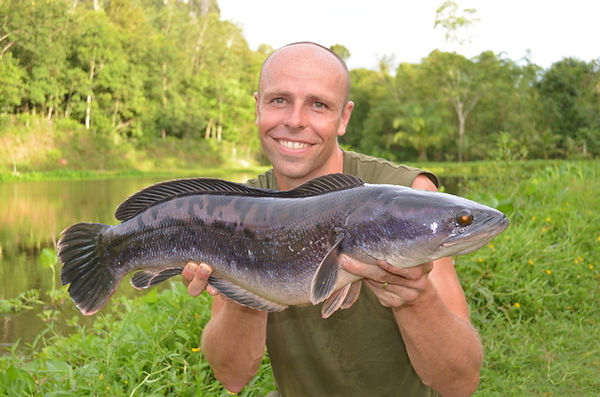
Name: Giant snakehead (shadow tomen). Species: Channa micropeltes. Thai name: Pla shado. Max length: 1m. Max weight: 30kg (65lb). IGFA record: 10kg (22lbs). Diet: Fish, mice and frogs. To fish for our giant snakehead you are best to use live frogs close to the water hyacinth beds, or they will occasionally take deadbait. Slow retrieves seem to work best, as snakeheads rarely chase down their prey. The snakehead is deadly at ambush tactics; they pounce with great speed and accuracy. Fish fry and small frogs are taken in one quick gulp, but with bigger prey the snakehead use their sharp teeth and powerful jaws to immobilize their victims, often cutting their prey in half. Snakeheads are great fish to target on the fly using floating lines and surface lures, as the takes are exhilarating. For targeting these fish we do allow 8wt tackle as the lures you use are small, and due to the fact you will be fishing the weeded margin you should not encounter the monster inhabitants of our lake. If you are planning to fly fish for these exciting fish, bring your own fly rods as we do not supply them. We suggest 8wt fly outfits with floating lines, and as with all hooks used at Gillhams they must be barbless. When bringing your own equipment you must show it to a senior guide prior to use, and their decision will be final as to whether it is safe to use on our fish. Please be aware Gillhams does not allow the use of extra light tackle, also we do not allow line class records to be pursued here, as our fish care is of utmost importance. General facts on the giant snakehead: The giant snakehead is native to Thailand and throughout South East Asia, while the true big specimens are located in Malaysia. Colouring of giant snakehead depends on the colour of the water they inhabit; in dirty water they are a very pale colour but in clear water they are brightly coloured in purples and greens. Our snakehead have dull purple bands with flashes of light green to a cream belly. Snakeheads are extremely territorial; they are very aggressive and will attack and bite anything that invades their space. At spawning time, which is around May/June at the start of the rainy season, the snakehead build a nest to lay their eggs in. It is rumoured among Thai fishermen that the adults guard the nest and will attack anyone who comes too close. They claim to have friends who have great lumps torn from their legs, but there is no scientific evidence to back these tales up. In the wild, snakehead prefer still water, and even swamps and stagnant water is tolerated as long s there is an abundant food supply. They are even found in rice fields, and when the water dries up they will bury in the mud and survive for many months. Big snakehead are solitary fish which hide amongst snags, trees and heavily weeded areas. They stay under cover for most of their lives, emerging only to feed, and they are rarely found in open water and seldom swim at midwater level, preferring to hug the bottom. Many rumours surround these popular Thai sporting fish. Thai fishermen claim the snakehead can travel over land to find new lakes and ponds. Snakehead have been recorded at weights of 35kg in the past, but fish over 9kg are now rare due to destruction of their environment and overfishing. Unfortunately for the snakehead species they are fantastic eating; in fact they are the Thai’s favorite eating fish, deep fried with sweet chili or garlic and pepper, and nothing goes to waste as heads and body parts all go into a fish soup. When you are in Thailand look for this delicious fish on the menu, and although most are farmed, they are a great tasting fish. However, all fishing at Gillhams is catch and release so you will not be trying them here!
Hovens Carp

Name: Hoven’s carp. Common names: mad barb, mad carp, river carp. Species: Leptobarbus Hoevenii. Cyprinidae. Thai name: Pla ba. Max length: 1m. Max weight: 10kg (21lb). IGFA record: 6kg (13lbs.3oz). Diet: Seeds and nuts, shrimp, worm, molluscs, insects, boilies, maize and bread. To fish for our mad carp, which act very similar to a European rudd, try small pieces of breadcrust tight to the hyacinth beds, or alternatively try float fishing approximately 18ins below your float close to the hyacinth beds with a single grain of maize or breadflake. For fly fishing, they will take a dry fly, especially hopper patterns, and also buzzer patterns fished in the surface layers with a very slow figure-of-eight retrieve. Again we allow the use of 8wt tackle for this fish, provided you only use floating lines and small flies. When hooked these members of the carp family dart from side to side, and regularly jump, so keep a tight line to them at all times. Once netted this rudd lookalike is no problem; they are very hardy, need no special care, and there are no sharp or dangerous areas to worry about. However they are a very lively fish so keep your hands away from their gills, as they will wriggle and jump from your hands given half a chance. Once you have your trophy shot, place the fish back in the water and support the fish until it is ready to swim away unaided. General facts on the Hoven’s carp: The mad carp is a member of the carp family cyprinidae; they are distributed from Thailand to Sumatra and Borneo, and found most often in freely flowing rivers and streams and seasonally on floodplains when they migrate into the flooded woodlands. During this period they eat parenchyma and seeds of chaulmoogra tree that have fallen into the water, and they become intoxicated and behave in a peculiar manner, hence the name mad carp or pla ba! During this period they are toxic, and eating the flesh of the fish can cause nausea in humans, but after this period they are prized highly as an eating fish, especially in Vietnam and Cambodia. After the floods they return to the rivers to spawn, where they reproduce very quickly, and populations can double in two years. The mad carp is also a popular aquarium fish, and under artificial lights with their green hue and red fins, they look spectacular in an aquarium, and are an easy fish to keep.

Indian Mahseer
Name: Indian Mahseer Species: Neolissochilus Thai name: Pla Wien Biggest known fish: 24lb 8oz. Lake rod caught record: 24lb 8oz Average weight: 6lbs Diet: Small Pellets, Fish, Shrimp, Snails & Worms. To fish for our Indian Mahseer, we recommend exactly the same approach as for our Thai Mahseer, you carefully select your intended swim, they like to keep close to the margin shelf and work there way along close to the hyacinths. Feed small baits like maize, small pellet, stick pellet and if you are staying a few days feed the swim up over two or three days. Fish a light lead or float with your bait scattered around, plastic maize or pellet seems to pick these up more frequently, but a close second is fruit flavoured pop-ups or more natural baits such as worm or snails. For even better results try moulding some sticky rice around your hook link, and then pulling your hair rigged pop-up into the rice ball. This method makes a deadly combination of a pop-up sitting over a small patch of rice. As with all the non-predatory fish in our lake, you need to create your own feeding area, and the tighter your feeding pattern the more fish you will concentrate in one area. The Mahseer is a bottom feeder, which has an under slung mouth with protruding lips, very similar to the European barbel. They rummage around the lakebed searching for food, and a giveaway to location in still conditions is look for pinprick clouds of bubbles breaking the surface. They are a shoal fish so once you have a shoal feeding keep the feed going in to hold them in your fishing area. They are very easily spooked, so when one is hooked let them run out of your baited area before playing them in. They are a very hard fighting fish for their size, and often fool you into thinking they are bigger than they are when they go on long, hard runs. Be prepared for some unusual antics from these hardy fish; they sometimes jump when hooked, and even when you think the fight is over be prepared for them to jump from the landing net. When targeting these fish may also catch Siamese carp, Pacu, Tambaqui, plus all our other smaller carp species. A lot of our anglers use one rod with plastic maize on their baited area, and then fish with a fish bait on the outside edge of the baited area for predators who have come into the food zone attracted by the small bait fish feeding on the groundbait.

Java Barb

Name: Java barb (silver barb). Species: Barbonymus gonionotus. Thai name: Pla tapien kao. Max length: 60cm. Max weight: 6kg (12lb). IGFA record: 2.31kg (5lbs 1oz.) Diet: Insects, shrimp, bread, maize, aquatic plants. These fish are not a target species and were never stocked in Gillhams. They occurred naturally, originating from the feeder stream, however they can be fun on light tackle. To fish for our Java barb you need to use a light float rod just tripping the bottom on the marginal shelf. Bait with cereal groundbait and fish either bread or maize on your hook. The Java barb is similar to the European roach in appearance, and the fight is very much the same. When targeting these fish you will also hook up our carp species, and for this reason we insist on minimum 8lb line strength, which, when used in conjunction with size 8 Drennan Super Specialist hooks, will handle accidental carp. Please do not release these fish back in the lake as they are breeding rapidly here; we have to net the fry on a regular basis and remove them. Ask our guides for a keepnet to retain this species in. For photos of these fish you do not need to get in the lake, but for the fish’s protection do photo them over grass. General facts on the Java barb: The Java barb is native to Thailand, Malaysia, Sumatra and Java. They are found in most water systems be it still water or flowing, even down to brackish water, although they do prefer still water. Java barb are silver in colour with orange and red tipped dorsal and caudal fins, and they have yellow pectoral and anal fins. The Java barb has a small head with a pointed snout and small barbules. They are considered useful in aquaculture for cropping excessive vegetation. The Java barb spawn on a regular basis all through the year, and if they are not controlled they reach pest proportions. Here at Gillhams we have a regular netting campaign to remove excessive fry. They are marketed fresh and considered a food fish by the Thais where they are ground up fine and are used in lap pla, a spicy minced fish dish. Alternatively they are mixed with garlic and rice, left to stand for one or two weeks, and then grilled to make a dish called som pla. If you wish to try this dish, good luck, as its pungent flavour (and smell) is not suited to the western palette! They are also used in the aquarium trade, mainly in basic aquariums, and as they need little care they are used mainly by children in their first aquarium setups.

Jau Catfish

Name: Zungaro zungaro, or jau catfish. Species: Pimelodidae siluriformes. Thai name: Pla jauhoo. Max length: 1.5m. Max weight: 100kg. IGFA record: 49.44kg 109lb. Diet: fish, squid, shrimp, frogs, scavenger almost any food item. The zungaro zungaro is a new species to Gillhams, only introduced in September 2010, and as such we cannot really give an accurate idea of how to target them. In their home of the Amazon and Orinoco rivers, the local fisherman use fish baits or squid, fished on the bottom at night. They will take flies fished on sinking lines with fast retrieves, so do not use any fly rods lighter than a 10wt with minimum 35lb leaders in conjunction with medium sized sparkly pattern flies. Zungaro fight hard and can turn incredibly fast; the sudden changes in direction often take the angler by surprise and result in lost fish. They hunt the deep silt channels especially during the first two hours of darkness; they are ferocious feeders and scavengers that will eat almost any bait. As with all our catfish they must be injected prior to release by our staff to ensure their wellbeing. They are very hardy fish, but not easy to photograph as they are extremely slippery – not unlike trying to hold a bar of soap! They do not like hot water temperatures so please take pictures and return them ASAP. General facts on the zungaro zungaro catfish: The zungaro are not indigenous to Thailand; they originate from South America on the Amazon and Orinoco river systems. They are a dark brown with a lighter belly with very faint darker spots on their heads and upper body, with one long whisker either side of their mouth. Their fins have long threadlike strands at the ends to give them fast turning speeds. In the wild they are mainly piscivorous and hunt at night, sometimes going into flood prone areas of rivers. They spawn in low water conditions gathering at river mouths where they lay their eggs in the slack water on a soft mud bottom. The young will stay in this area until they reach 2kg, at which point they venture back up the rivers. They reach sexual maturity at around 10kg, which is normally after three years. Both the Amazon and Orinoco rivers boast healthy populations of these fish. Our zungaro are a first generation of fish bred here in Thailand for the aquarium trade.

Julians Golden Carp
Name: Julian’s golden carp Species: Probarbus Jullieni. Thai name: Pla yissok. Max length: 2m. Max weight: 70kg. IGFA record: Vacant. Diet: Aquatic plants, Insects, shellfish, prawns, maize, pellet, boilies, sticky rice. To fish for our Julian’s golden carp we recommend you plumb the depth of your intended swim, find a depth of around 4 meter, feed maize with small pellet, and if you are staying a few days feed the swim up over two or three days. Fish a light lead or float with maize and pellet scattered around, maize is the no1 bait here at Gillhams, but a close second is fruit flavored pop-ups. For even better results try moulding some sticky rice around your hook link, and then pulling your hair rigged pop-up into the rice ball. This method makes a deadly combination of a pop-up sitting over a small patch of rice. As with all the non-predatory fish in our lake, you need to create your own feeding area, and the tighter your feeding pattern the more fish you will concentrate in one area. The Julian’s golden prize is a bottom feeder which has an underslung mouth with protruding lips, very similar to the European barbel. They rummage around the lakebed searching for food, and a giveaway to location in still conditions is look for pinprick clouds of bubbles breaking the surface. They are a shoal fish so once you have a shoal feeding keep the feed going in to hold them in your fishing area. They are very easily spooked, so when one is hooked let them run out of your baited area before playing them in. They are a very hard fighting fish for their size, and often fool you into thinking they are bigger than they are when they go on long, hard runs. Be prepared for some unusual antics from these hardy carp; they often jump when hooked, and even when you think the fight is over be prepared for them to jump from the landing net. When targeting these fish you will also catch Siamese carp, plus all our other carp species, along with the Mekong catfish. A lot of our anglers use one rod with maize on their baited area, and then fish with a fish bait on the outside edge of the baited area for predators who have come into the food zone attracted by the small bait fish feeding on the groundbait. There are no real concerns with these tough carp species, and they require no special care, but as with all our fish please handle with care, use barbless hooks only and only photograph in the water with a quick release. General facts on Julian’s golden prize carp: This stunning looking carp is regarded by many as the prettiest of all carp species, hence their name. They really are a golden prize with their golden brown scales, and vivid black lines running the full length of their bodies with black and red tipped fins. Their natural habitat is slow moving large rivers and they prefer sandy or gravel areas of the riverbed where they feed on molluscs and shrimp. The Julian’s golden prize is not a lake dweller; they exist in lakes due to man stocking them, where in fact they thrive. They do not spawn in still water but are known to go through the motions of spawning. In the wild they spawn in late December through to February depending on non-flood conditions with a constant temperature of 23C for several days, and their eggs hatch 36 hours after being laid. In the past they have been recorded at weights in excess of 70kg (150lb) but wild fish nowadays rarely exceed 20kg (45lbs), their downfall being their high market price due to their fine eating qualities. The Thais actually prefer to eat them raw or lightly steamed. They are farmed throughout Thailand as a food source where there local name is pla yissok. The ideal table fish at the quickest attainable weight is 5kg (11lb), hence the shortage of good sized fish available to commercial fisheries.


Mekong Catfish


Name: Mekong catfish. Species: Pangasianodon gigas. Thai name: Pla buk. Biggest known fish: 300lb Lake rod caught record: 280lb Max length in excess: 3m. Max weight: 300kg. IGFA record: 117.933kg (260lbs), caught here at Gillhams Fishing Resort. Diet: Plankton, plants, shrimp, sticky rice, boilies, pellet, cereal and maize. Gillhams Fishing Resort in Krabi are the holders of the IGFA world record with a fish caught by David Kent on 29th November 2010 weighing 117.933kg (260lb) We also held the previous last two records with different fish caught by Joe Ball on 14th December 2009 and Rob Maylin on the 28th May 2008 weighing 84kg. (185lb 2oz.) To fish for our Mekong catfish we recommend pellet or boilies and pop-ups, also maize fished in conjunction with a method feeder. Using a marker float find a plateau and fish over this feature using a float set at around one meter, loose feed pellet every five minutes feeding little and often brings the best results. Mekong catfish will also feed on the bottom use a pop-up, pellet or maize and once again find your spot and keep topping up the bait, as these are shoal fish with huge appetites. The Mekong catfish is one of the hardest fighting fish in freshwater; the more you pull the more they pull back. At all times, as with all fishing here, keep checking your drag settings, as one mistake and the result is a lost fish. Our Mekong range from 90lbs to 300lbs, and once hooked expect a fight of at least 45 minutes! Also our Mekongs were bought up on a diet of pellet, which was unheard of as a bait in most fisheries until we started using them. We even had one caught in December 2007 on a tilapia livebait, and this was one of the only Mekong we or our fish suppliers have ever heard of to fall to live bait. In the wild the Mekong catfish is regarded as a plankton feeder. Our lake has an obscene amount of shrimp – we can net 2kg inside five minutes at night, also at certain times of the year we have huge amounts of zoo plankton. The Mekong, as with all our fish, get preoccupied on this nutritional food source, making them hard to catch, but lots of bait in a concentrated area will switch them onto your bait. The Mekong is one of the hardiest species in Thailand, but take note of our guide’s advice. General facts on the Mekong catfish: Mekong giant catfish, the world’s largest scaleless freshwater fish, have very low-set eyes and are silvery dark grey. They are toothless herbivores who live off the plants and algae in the river. Juveniles wear the characteristic catfish whiskers, called barbules, but these features shrink as they age. Highly migratory Mekong catfish require large stretches of river for their seasonal journeys and specific environmental conditions in their spawning and breeding areas. They are thought to rear primarily in Cambodia’s Tonle Sap Lake and migrate hundreds of miles north to spawning grounds in Thailand – they will not spawn in still water. They are bred artificially on fish farms such as our friend Mr Toe’s, who is involved with the restocking programme for the Mekong river. We only buy our Mekong from a reputable source such as Mr Toe, and unlike some commercial fisheries none of our fish of any species have been taken from the wild. Once plentiful throughout the Mekong basin, population numbers have dropped by some 95 percent over the past century, and this critically endangered fish now teeters on the brink of extinction. Overfishing is the primary culprit in the giant catfish’s decline, but damming of Mekong tributaries, destruction of spawning and breeding grounds, and siltation have taken a huge toll. Some experts think there may only be a few hundred adults left in the wild today, and international efforts are underway to save the species. It is now illegal in Thailand, Laos, and Cambodia to harvest Mekong catfish. On 9 June, Thailand marked King Bhumibol Adulyadej’s 60th year on the throne. A crowd of over half a million people gathered in the nation’s capital, Bangkok, prisoners were released, and fishermen in the north of the country declared they would no longer catch the Mekong giant catfish. Instead, they will hand over their nets to the government, in return for $500 per net. In a further bid to safeguard the species, the Thai Department of Fisheries has released approximately 10,000 captive-bred individuals into the Mekong river since 2000. However, enforcement of fishing restrictions in many isolated villages along the Mekong is nearly impossible, and illicit and bycatch takings continue along with sales to commercial fisheries. The largest catch recorded in Thailand since record-keeping began was a female measuring 2.7m in length and weighing 293kg (646 lb). This specimen, caught in 2005, is widely recognized as the largest freshwater fish ever caught. Thai Fisheries officials stripped the fish of its eggs as part of a breeding programme, intending then to release it, but the fish died in captivity and was sold as food to local villagers.

Marbled Goby
Name: Marble Goby Species: Oxyeleotris marmorata Thai name: Pla Bu. Biggest known fish: : 5lb 8oz. Lake rod caught record: 12kg (25lb). Average weight: 3lb. Diet: Fish chunks, pellet, worms, prawns, aquatic insects, mollusks, crabs and small fish. To fish for our marble goby, worms are a top bait and also small pieces of fish or meat. They are quite a lazy fish and will not search out food in the daytime, but rather sit and wait for their opportunity to pass them by, they prefer to be more predatory in the darker hours after the sun sets and night kicks in Once you have found a likely looking location, fishing with a lighter set up and smaller hook next to the floating hyacinth is the most likely method of tempting one of these to take your bait. Either fishing with a float set up mid water lipping the hyacinth or a lighter lead or bubble float on the bottom could be the key to securing this rare visitor to the bank. Species Info The Marbled Goby in Thailand is the largest known gobioid fish, their appearance is torpedo like in body with a flat head. The Marbled Goby is also known as the Marbled Gudgeon or Marbled Sleeper and is a commonly found near muddy margins and pools off tidal rivers. This species has an oblique mouth with two dorsal fins and rounded caudal fin and has a brown body with dark shading giving a unique camouflaged marbled appearance. The Goby is a carnivorous member of the Eleotridae – Sleepers family of fishes which is widely found throughout Southeast Asia in countries including Laos, Cambodia, Vietnam, Thailand, Malaysia, Sumatra and western Borneo and has been found further afield also. Notoriously the Marbled Sand Goby is a nocturnal hunter that hunts slow-moving streams, lakes, ponds and swamps. In the daytime this fish sits at the bottom, hiding among rocks, debris or vegetation. The Marbled Goby primarily eats small fishes, but also takes crustaceans, insects, and mollusks. Marbled Goby are a sort after food fish throughout Asia and may be declining in some areas due to it being seen as a delicacy eating fish. It’s also said to have ‘medicinal healing properties’ by the Chinese community throughout Asia. In the wild Marbled Goby can be caught whilst fishing with prawns, worms and small live baits in quiet marginal areas.


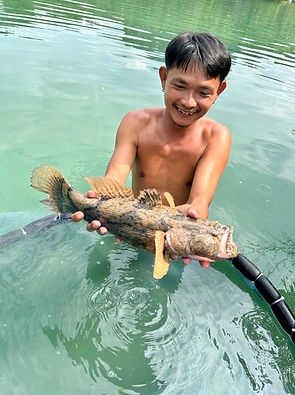
Mrigal Carp

Name: Mrigal carp (Asian grass carp, silver carp, small scale mud carp). Species: Cirrhinus cirrhosus. Thai name: Pla nuan tjan. Max length: 1.2m. Max weight: 20kg (43lb). IGFA record: 8kgs (17lb-10oz.) Caught here at Gillhams fishing resorts. Diet: Water plants, banana, vegetables, insects, shrimp, worm, pellet, boilie, maize and bread. To fish for our mrigal, try float-fishing the marginal shelf with maize or breadflake alternatively loose feed small pellets, bread crust, floating pellets also work fished as a surface bait. They will occasionally take a dry fly, especially hopper patterns, and again we allow the use of 8wt tackle for this fish, provided you only use floating lines and small flies. When hooked these members of the carp family take off like a steam train, so make sure the drag on your reel is set to 20% of the main line’s breaking strain, or you will be broken off on the first run. Once the mrigal slows down, increase your drag setting. These fish occasionally jump when hooked, so keep a tight line to them at all times. Once netted this chub lookalike is no problem; they are very hardy, need no special care, and there are no sharp or dangerous areas to worry about. However they are a very lively fish, so keep your hands away from their gills, as they will wriggle and jump from your hands given half a chance. Once you have your trophy shot place the fish back in the water and support the fish until it is ready to swim away unaided. General facts on the mrigal: The mrigal is a member of the carp family cyprinus. The mrigal is naturally distributed in south Asian countries, Bangladesh, Cambodia, India, Laos, Malaysia, Mauritius, Myanmar, Nepal, Pakistan, Sri Lanka, Thailand and Vietnam. They have been so widely distributed for aquaculture that their natural distribution can no longer be determined. Similar in appearance to the grass carp, the mrigal is small scaled with a smooth scaleless head, and the mouth has a protruding top lip with small pads to the lower top lip. They have a torpedo shaped body, which gives them their speed. In the wild they inhabit fast flowing streams and rivers they can only spawn in swift water over a sandy bottom. The mrigal thrives in lakes and ponds but has to be artificially spawned. They are the most widely farmed species in South Asia where they are an important component of carp polyculture, and being a very hardy fish they can tolerate low oxygen levels and poor water quality. The mrigal spawns up to three times a year, which is why they are such a popular farm fish. Farmed as a food source the mrigal is a tasty fish, and despite having numerous fine bones it has a high market value, usually used when fresh in fish soup or steamed with ginger, but they are also dried and salted then sold as preserved fish, making them very popular in the poorer areas of Asia where there is no refrigeration. As these fish are farmed and sold at weights around 5kg, their true potential has yet to be seen in a lake such as Gillhams with huge amounts of natural food, plus with it being a still water it will be interesting to see what weights they will attain.

Ocellate Stingray/Peacock-Eye Stingray
Name: Ocellate River Stingray or Peacock-Eye Stingray Species: Potamotrygon motoro Thai name: Pla kabeng Amazon Biggest known fish: 80lb Lake rod caught record: 65lb Average weight: 40lbs Diet: Giant Water Snail, Fish, Shrimp, Prawns, Crustaceans, Squid. To fish for our peacock-eye stingray we recommend using the worms as the most successful bait, but meat from the giant freshwater snails or alternatively you can use very small fish sections. A fluorocarbon hooklink would be preferable, but these fish are not riggy at all, braided hooklink will work just as well. Indication begins with a few knocks on the line, similar to a continuous jerking feel, as first the stingray settle over the bait, as they slide over the bait to position the food into their small mouth. Takes from the stingray can be very fast, and once they realise something is wrong they kite around, making short sharp turns, so keep the pressure to the maximum or the stingray will lock onto the bottom. Should they do this, try walking back in the swim and applying pressure from different angles to get them swimming. Once the stingray is on the move, it will glide through the water at speed, so keep maximum pressure on at all times or they will go over a plateau and once again anchor to the lakebed. Each time they lock on the lakebed they are harder to move again. All the time they are sitting like this on the lakebed, they whip their razor sharp tail until eventually they hit the line and it is all over. The best areas for stingray are alongside the hyacinth beds, where they hunt for water snails. When you have caught one of these fish take note of our guide’s instructions on how to handle them, different to the Asian giant stingray, we can not remove the barbs from them as it will kill the fish, so the guides will cover the barbs for you and instruct on the best manner of handling them.


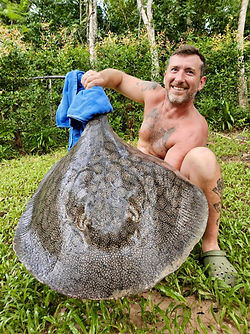


Piraabia

Name: Piraiba, or Lau lau. Other names: Bagre blanco, blanco pobre. Species: Brachyplatystoma filamentosum. Thai name: Pla pireeba. Max length: 3.6m. Max weight: 250kg. IGFA record: 155kg (341lb.11oz.) Diet: fish, pellet, frogs, waterfowl, monkeys, scavenger almost any food item. The piraaiba is a new species to Gillhams; we have been trying to obtain these awesome catfish ever since we came to Thailand, and we believe these fish will eventually take over as the main target fish for travelling anglers once they reach weights over 50kg, which on our reckoning will be within five years! We only introduced piraaiba in September 2010, and as such we cannot really give an accurate idea of how to target them. However in the wilds of South America they are fished for in the slack water below rapids and waterfalls, using large fish chunks on the riverbed. They are reputed to be one of the hardest-fighting freshwater fish on the planet. They make long, hard, deep runs, never giving up, and they can also turn at very fast speeds in a tight area. It is believed that in lakes such as ours they would take large flies on sinking lines. There is very little information on fly fishing for them, but as with all large flies fished here you must use a 12wt fly rod and line with a minimum 35lb leader. They seem to prefer deep water over soft bottoms, so we would recommend trying for them in the silt channels that run round the central plateaus. Use large fish chunks in conjunction with our sunken bubble float method to create minimum resistance, and please ask on arrival for any updates if you wish to target this powerful catfish. As with all our catfish they must be injected prior to release by our staff to ensure their wellbeing. They are very hardy fish but do take care of their sharp pointed pectoral fins when holding them for a photo. They do not like hot water temperatures so please take pictures and return them ASAP. General facts on the piraaiba or lau lau: The piraaiba are not indigenous to Thailand; they originate from South America: Amazon and Orinoco river basins and major rivers of Guiana and Northeast Brazil with reports also of them in Argentina. They have a grey upper body with a cream belly and a very pronounced lateral line. It is a member of the shovel nosed catfish family with medium length whiskers. The top lobe of their tail has a long threadlike ending, which gives them incredible speed and turning ability. They spawn in river mouths over soft mud, but spawning is more successful when they can reach brackish water. Piraaiba do not reach sexual maturity until they are 14 years old, which along with commercial fishing for their fine eating qualities is one of the leading factors in them being on the endangered species list. Their preferred diet is other fish, but since they are scavengers of any dead animal, their stomachs have been found to contain monkeys and even human remains! The piraaiba here at Gillhams are the first to be spawned artificially here in Thailand. As with the Amazon red tail catfish, once a breeder has stripped these fish of their eggs once, they can no longer reproduce, making them only valuable to sell to commercial fisheries like ours.
Red Bellied Pacu
Name: Red Bellied Pacu Species: P. Brachypomus Thai name: Pla Jaramet Biggest known fish: 42lb Lake rod caught record: 42lb Average weight: 20lbs Diet: Boilies, Pop ups, Fruit, Seeds & Nuts. To fish for our red bellied pacu try to fish on top of the plateaus over a bed of boilie and pellet with a fruit pop-up, especially pineapple. The pacu is often called a vegetarian piranha, but although they prefer fruit, nuts and vegetables they will eat almost anything as they are opportunist feeders. They never eat live fish, but will sometimes take fish chunks. They have blunt teeth like a human, and they use them in the wild to crush hard nuts. You do not need wire, but strong braided hook links are recommended due to the added risk of them biting through the braid. When hooked the pacu will go on short, sharp runs, constantly changing direction and spinning in circles. Once they spot the landing net they will dive and turn using their body mass to shed the hook, and most pacu are lost at the landing net stage of the fight. Species Info The red bellied pacu is a relative of the piranha group of fish found in South America and is a member of the Characiformes (characins) family of fish. The wild pacu feed on fruits, small fish and seeds that fall into the river. You can definitely tell they are from the piranha family due to the visual similarities. Looks wise the red bellied pacu has an awesome set of teeth very similar to those of a human, these teeth are seriously strong and can easily crush seeds and nuts with one jaw motion. This pacu is a highly sort after target fish from its original base of origin the Amazon, to the lakes that they are stocked around the globe. The fish is known to jump once being hooked and can make excellent sport on the end of a fishing rod.

Ripsaw Catfish

Name: Ripsaw catfish. Common names: Niger, black talking catfish, plated catfish. Species: Oxydoras niger. Thai name: Pla niger doradidae. Max length: 1.2m. Max weight: 40kg (90lb). IGFA record: 21.5kg (47lb 6oz) Diet: Shrimp, worm, molluscs, insects, maize pellet and bread. To fish for our niger catfish; try fishing bread flake or worms alongside the water hyacinth beds, especially in the corner silty areas where they sift through the silt scavenging amongst decaying water plants. These gentle members of the catfish family will be pushed off food by other fish, so avoid free offerings in large quantities, and fish the bait hard on the bottom under a float. When feeding these fish can be spotted by the clouds of bubbles made when they are sifting through the soft muddy areas of the lakebed. When hooked they try to get under the water hyacinth beds, which are floating weeds used as a filter system here, but just put your rod tip under the water and pressure them out into open water. They will keep making repeated attempts to get back into the sanctuary of the weedbeds. Once you have landed one of these prehistoric fish, please heed our guide’s advice, as they have very sharp armored scales running down their lateral lines, plus sharp thorn-like hooks attached to their razor sharp scales. Do not attempt to pick these fish up without a glove or towel; they are docile for pictures and very hardy fish that, unlike other catfish, do not require an injection. General facts on the niger catfish: The niger is a member of the doradidae family; they are a dull black colour with a green tinge and large barbules on either side of their underslung mouths. They have armored scales running down the lateral line with sharp thorn-like hooks protruding off their scales. They are found throughout many of the major river systems of northern South America – Ecuador, Colombia, Venezuela, Guyana, Peru, Bolivia and Brazil. A population is also thought to exist in the Rio Orinoco. Their natural habitat is muddy areas of slower moving water or lakes where they consume anything edible they find while sifting through the substrate. A large proportion of their diet is composed of crustaceans and the larval forms of various insects. The niger takes a long time to reach sexual maturity, and being slow to reproduce has placed them as code red on the endangered species list. They are thriving here in Thailand where they are a very popular aquarium fish; they scavenge the bottom of the tank, keeping it clean. They soon outgrow tanks, which is when commercial fisheries like ours purchase them. All the nigers at Gillhams were purchased from the aquarium trade.

Rita Sacerdotam
Name: Rita Sacerdotum Species: R. Sacerdotum Thai name: Pla Duk Rita Biggest known fish: 93lb Lake rod caught record: 93lb Average weight: 35lbs Diet: Fish, Pellet, Worms, Mollusks, Crustaceans, Insects. To fish for our Rita Sacerdotum catfish; try fishing bread flake or worms alongside the water hyacinth beds with a method feeder, especially in the corner silty areas where they sift through the silt scavenging amongst decaying water plants. These gentle members of the catfish family will be pushed off food by other fish, so avoid free offerings in large quantities, and fish the bait hard on the bottom under or tripping bottom under a float. When feeding these fish can be spotted by the clouds of bubbles made when they are sifting through the soft muddy areas of the lakebed. When hooked they try to get under the water hyacinths, which are floating beds of weed used as a filter system, but just put your rod tip under the water and pressure them out into open water. They will keep making repeated attempts to get back into the sanctuary of the weed beds. Once you have landed one of these fish, please take our guide’s advice they are docile for pictures and very hardy fish. Species Info The Rita Sacerdotum catfish is a very elusive indigenous Asian catfish species. Reports suggest it can grow to a length of two meters. They have been located in various parts of South East Asia including Myanmar and the Mekong basin in Thailand. The catfish is a member of the Bagridae family of fishes, which live in large rivers, it will feed in the wild on small organisms and small fish. The Rita Sacerdotum catfish is a very rare fish to catch and definitely a prize for any angler lucky enough to have one on the end of their line. It is another of the scale less type of Thai catfish, with a thick body and head, which is mainly of a lighter grey colour throughout and is equipped with sensory barbels which it uses to seek out food and prey in its natural environment. Rita Sacerdotum have a large tail and fins of a similar greyish colouration this Thai Catfish has the potential to grow to a large size in the correct environment.


Rohu

Name: Rohu (yissok tet, rahoo carp). Species: Labeo rohita. Thai name: Pla yissok tet. Max length: 1m. Max weight: 40kg. IGFA record: 34lbs.4ozs-15.6kgs. Caught here at Gillhams fishing Resorts. Diet: Shrimp, plankton, plants, fruit, maize, boilies, pellet, sticky rice and cereal-based baits. To fish for our rohu use the same tactics as for Julian’s golden prize. We recommend you fish the bottom of the margin shelf and bait up with small pellet or maize feed little and often, float fishing or a light lead is best for these shy feeders its sometimes worth trying a small pop up try moulding some sticky rice around your hooklink then pulling your hair rigged pop-up into the rice ball.This method makes a deadly combination of a pop-up sitting over a small patch of rice. As with all the non-predatory fish in our lake, you need to create your own feeding area, and the tighter your feeding pattern the more fish you will concentrate in one area. This member of the carp family has a small mouth with sharp cutting edges for feeding on water plants, but take care when playing these fish though as they have very soft lips. This carp will also jump when hooked, sometimes attaining heights of two metres! When targeting these fish you will also catch Julian’s golden prize carp, Siamese carp, plus all our other carp species, along with the Mekong catfish. A lot of our anglers use one rod with maize on their baited area, then fish with a fish bait on the outside edge of the baited area for predators who have come into the food zone attracted by the small bait fish feeding on the groundbait. The rohu is not as hardy as the other carp species, so please take extra care when handling them, get your camera ready beforehand, then snap off a couple of quick shots before placing them back in the landing net to recover. As with all our fish, use barbless hooks and only photo in the water. General facts on rohu: The rohu is a member of the carp family cyprinidae. They are distributed from Thailand through Myanmar to India and Pakistan. The rohu looks similar to a common carp with a scaled body and non-scaled head; the main difference being their protruding lips. They are a light brown colour with a pink tinge outlining their scales and fins. As fry they feed exclusively on zooplankton composed of rotifers and cladocerans, but as they grow they start to feed on algae then water plants. They do not develop a taste for maize or other food items till they reach maturity at two years old. In the wild they spawn in the shallow margins of flooded rivers, preferring grassland, but the rohu does not spawn in still water. They are farmed throughout Asia where they are artificially spawned and stripped of their eggs. They are considered a delicacy in India, especially their roe, and their white, non-oily flesh is cooked deep fried in mustard oil. They are also farmed here in Thailand as a sporting fish, and their popularity comes as a hard fighting fish on light tackle, which makes spectacular leaps when hooked. The rohu has been recorded jumping up to three metres.
Siamese Carp
Name: Siamese carp (giant barb, cahoor). Species: Catlocarpio siamensis. Thai name: Pla cahoor. Biggest known fish: 275lb Lake rod caught record: 206lb Max length in excess: 3m. Max weight: 300kg. IGFA record: 60kg (134lb) caught here at Gillhams Fishing Resort. Diet: Shrimp, plankton, plants, fruit, maize, and cereal-based baits. To fish for our Siamese carp we recommend the use of our pellets and boilies (bottom baits or pop-ups). The best flavours are fruits or shellfish, used in conjunction with PVA bags or method feeders with accurate casting to a set spot to get the best results. Siamese carp, as with their European cousins, love to follow a new wind, so fishing into a headwind brings the best results. Our fish seldom feed off the top, and seem to prefer depths around 3 to 5m on a sandy bottom. Siamese carp are very hard fighting, making sudden lunges, so be prepared for their second wind when you think they are beaten. As with all species in the tropics, they do need a little time to recover once in the net, so while they are recovering get your camera ready, remove all watches and jewelry, and enter the water for your photo. They are a very hardy fish, but due to the heat and exhaustion from the fight, we insist on a brief time for photos. General facts on Siamese carp: The Siamese giant carp is the largest species of carp in the world. These migratory fish are found only in the Mae Klong, Mekong and Chao Phraya river basins. They are a desirable food fish, which has caused a serious decline in their numbers. They are usually found in the big pools along the edges of large rivers, but will seasonally enter smaller canals, floodplains and flooded forests. Young barbs are usually found in smaller tributaries and swamps, but can acclimatize to living in ponds, canals and swamps. These are migratory fish, swimming to favourable areas for feeding. They breed in October, and they do not spawn in still waters. Their head is rather large for the body, and they have huge mouths. There are said to be no barbules, however if you look closely some do have tiny single barbs on either side of their lower lip. The Siamese carp are among the largest freshwater fish in the world, and are probably the largest fish in the family cyprinidae. Large examples of this species can be 3m (10ft) and 300kg (660lb). Among the carp family only mahseer have reached comparable dimensions, but large mahseers have only been recorded in centuries past. Cyprinids are highly important food fish, and they are fished and farmed across Asia. In certain places they remain popular for food as well as recreational fishing, and have been deliberately stocked in ponds and lakes for centuries for this reason. It is the largest family of freshwater fish, with about 2,420 species of cyprinids in about 220 genera. The family belongs to the order cypriniformes.


Spotted Featherback
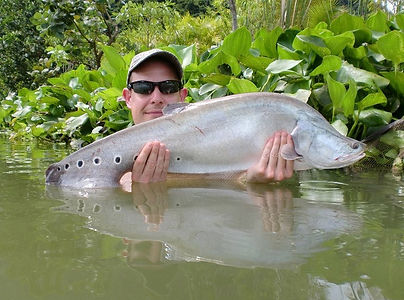
Name: Spotted featherback. Species: Chitala ornata. Thai name: Pla klaey. Max length: 1m. Max weight: 12kg. IGFA record: 6kg. Diet: Small fish, shrimp, worms, crustaceans, and insects. To fish for our spotted featherbacks worms and live shrimp are the top baits. They feed best during and straight after rain especially during the first two hours of dark. Fish on top of the plateaus in the shallower end of the lake. They are cautious feeders and will drop a bait if they feel any resistance, so use a light lead on a stem leading to a small float attached to a run ring. Use a cork ball or small polyball as your buffer bead, and set the indicators at their lightest setting with plenty of slack line to the rig. Takes will be slow, jerky short pulls, which can go on for a few minutes, but wait until the featherback takes of on a slow, deliberate run. On the strike be ready for the featherback to make a fast jump and back flip as they try to shed the hook, but unlike other jumping fish, keep the line tight when they jump. As the featherback approaches the landing net they will jump again, so stick to the same tactics as before. As soon as the fish is in the net you will have seconds to take a quick picture. We have learnt with these fish that they will not tolerate being handled or restrained in a net, so for this reason you should have your camera ready and hold the fish up for a very quick photo. When our guides tell you enough, stop and release the fish for someone else to enjoy. General facts on the spotted featherback: Spotted featherbacks are also known as knifefish or clown knifefish due to their long, knife-like bodies. Featherbacks are usually are found in lakes, swamps, and river backwaters. They prefer still waters and can survive with low oxygen. They prefer low light levels, and mainly these fish are nocturnal, usually cruising during the twilight hours. They hunt live prey and will try any fish that fits into their mouths. Young featherbacks usually school near logs and plants for security, whereas more mature specimens become territorial and eventually become loners. These fish can also breathe air to survive in stagnant waters with low oxygen. Featherbacks are a very distinct silvery grey with a long, knife-like body with a long anal fin. Mature fish normally have 5-10 (or even more) black spots ringed with white that usually increase in number and size as the fish grows. Juvenile fish have striped bands instead of spots. Their long anal fins enable them to make graceful forward and backward movements. They have two nasal tentacles above their large toothed mouth. In the center of the body there is a flag-like dorsal fin, but they have no ventral fins. Most featherbacks are afflicted with cloudy eye colour when they age, but this is perfectly normal. Featherbacks come from Southeast Asia, specifically Thailand, Borneo, Malaysia, India, and Sumatra. Featherbacks spawn at the start of the rainy season end of May to June in flooded grassy areas. In our lake they spawn once we have three days of continual rain, usually in June, when they take refuge in the water hyacinths in the top bay. Spawning is at night over a three-day period

Spotted Sorubim
Name: Spotted sorubim. Species: Pseudoplatystoma coruscans. Thai name: Pla sira dang. Max length: 1.5m. Max weight: 70kg. IGFA record: 53.5kg. Diet: Fish, squid, frogs, earthworms, crustaceans, shrimp. To fish for our spotted sorubim we recommend you try sea fish dead baits cut in half or squid fished on the bottom in conjunction with a cage feeder filled with minced fish and fishmeal mix. Fish close to the margins tight to the water hyacinth beds. These fish hate bright sunlight, so your best times to fish for these tough fighting fish is on overcast days, especially in the rainy season. During the hot dry season the sorubim only feed at night, feeding best for the first two hours of darkness. In this period they feed ferociously as if the world is about to end, and it is not uncommon to catch the same fish twice in a couple of hours when they are on their feeding frenzy, but after this time the fishing slows down. Another way to tempt these fish is to fish tight to the fishing platforms after dark, as they have learnt that most fishermen, when changing their fish baits, throw the discarded bait into the margins, and the sorubim, being opportunist feeders, have cashed in on this prebaited situation. Expect takes to be savage and fast, and the spotted sorubim fight hard making repeated long, fast head-shaking runs. They give their all in the fight and for this reason must be given time to recover. As with all our catfish they will be injected by our guides then given time to recover before a quick picture and release. When handling these fish be aware they have sharp pectoral and dorsal fins which can inflict a nasty spike to you. Other than these features there are no other parts to worry about, and they do not posses teeth – as with most catfish they just have tough pads in their mouths. General facts on the spotted sorubim: Spotted sorubim are also known as the shovel nosed spotted catfish. As with many species in Thailand they were introduced here for the aquarium trade. Their heads are three times longer than they are wide. The eyes of the spotted sorubim are set to enable them to see up and down, and coupled with extremely long whiskers they are adept at hunting out food items in all conditions. They have a brown upper body with a cream coloured belly, and their upper body and fins are covered in black spots and lines, This colour pattern allows the fish to blend in whether you’re looking up at it against the sky or down at it towards the bottom. They spend most of their day hiding among tall reeds or tree roots, where they rest vertically to blend in with their surroundings. They use their camouflage to wait for unsuspecting prey to pass by, and also to hide from bigger predators. When these fish are active they swim in a normal horizontal position. The spotted sorubim is a social fish that lives in groups, and they are mainly nocturnal. They can adapt to life in fast, slow or still water, and they prefer a sandy bottom and seem to avoid silted areas. They are a slender fish from the rivers of the Amazon, Venezuela and Paraguay. The body is very elongated and built for speed. They breed after floods as the waters recede and are thought to spawn more than once a year if conditions allow. They have been observed excavating a small pit as a nest and guarding newly hatched fry, but as they need constant running water to breed and hatch their young, they will not breed here at Gillhams.


Stripped Snakehead

Name: Striped snakehead (chevron snakehead). Species: Channa striata. Thai name: Pla tjon. Max length: 1m. Max weight: 5kg (10lb). IGFA record: 7lbs.14ozs-3.6kgs. Diet: Fish, shrimp, insects, prawns and frogs. To fish for our striped snakehead the best methods are to use very small fish baits or live shrimp fished below a light float setup in the margins. For these mini battlers ask for a light float rod setup to get maximum sport from these aggressive predators. Alternately the striped snakehead is a great fish to target fly fishing. Use a floating line and shrimp pattern fished along the margins on a floating line. These well camouflaged fish hide in the reeds and hyacinth beds, so fishing as close as you can to these structures will produce the best results. Takes are vicious as the snakehead devour their prey in one gulp. We do allow 8wt outfits, but no sinking lines to target these fish. Once hooked the striped snakehead make sharp zigzag runs, always trying to reach the sanctuary of the reeds. When they take you under the water hyacinths don’t worry, as these plants are used as natural filters; they are tied back to the banks and are a non-rooting floating weed, so just sink your rod tip and bring the fish back out. These fish are very hardy and apart from the obvious ‘don’t put your fingers in their mouths’, they have nothing else to worry about. They are slippery and wriggle a lot when trying to photograph them, so be prepared, and once you have your picture place them back in the water and they will shoot off in a puff of mud. General facts on the striped snakehead: The striped snakehead is native species to Thailand, and they have a widespread range throughout Asia, China, Pakistan, and India, and in recent years they have been introduced to the Philippines and Mauritius. They Inhabit ponds, streams and rivers, preferring the stagnant and muddy water of plains, and can be found mainly in swamps and rice fields. Striped snakehead are brown in colour with faint black bands across their entire body. They have a cream belly, a large head reminiscent of a snake’s head with a deeply-gaping fully toothed mouth, and a large-scaled cylindrical body. When the snakehead eats it is a thrust predator. It will eat its prey all at once, striking and inhaling it whole. The snakehead has adapted to breathe air using a primitive form of a labyrinth organ, which is why they are able to survive in dried-out waterways by burrowing in mud, and as long as their skin and air breathing apparatus remain moist they can live on stored body fats. There are 29 known snakehead varieties, and they can travel across land and live out of water for up to three days. Out of the water snakeheads rhythmically move their fins and muscular bodies back and forth; the fish equivalent of walking. It is a resourceful adaptation, as in their native Asia they must survive both wet and dry weather cycles like monsoons and droughts. Males and females both help to construct a nest out of water vegetation during breeding time, and the eggs are guarded by the male. They breed up to five times a year, laying 15,000 eggs each time. Because of their unique survival technique they are considered in Asia as a medical tonic, helping to cure illness. They are an important food fish throughout Asia, also used in culture ponds to control tilapia. In Thailand the snakehead is probably the favourite fish, having a firm white flesh that is almost bone-free, and which is cooked in many ways. The heavy, dark skin is good for soup and usually sold separately. If you wish to sample these fish in our restaurant please order them the day before, as we do not kill any fish in our lake; we buy them from the local market. When snakeheads are kept in captivity they will try anything to escape a confined environment in aquariums; they will charge full force into the glass either knocking over small aquariums or shattering the glass, they often die in their attempt to escape, which is why you seldom see them in captivity. Recently a striped snakehead was reported to have been caught in Lincolnshire, England with a photo to back up the evidence, however it was later proved to be a hoax.

Tambaqui
Name: Tambaqui. Species: Colossoma macropomum. Thai name: Pla jermet. Max length: 1.2m. Max weight: 40kg. IGFA record: 32.4kg (71lb 7oz.) Diet: Fruit, water plants, nuts, insects, shrimp, maize, bread, pellet and boilies. To fish for our tambaqui, fish the same tactics as you would for their close relation the black pacu. They do have a distinct liking for maize, especially if you soak it in fruit flavourings. As with pacu, float fish alongside the water hyacinth beds, and they occasionally get caught on the plateau tops. The tambaqui is a great fish to target on fly rods using surface bugs and hopper patterns on floating lines. When they take do not strike, but wait for the line to tighten or you will miss them, due to their human like teeth, which they use to crush nuts. These teeth are not sharp, but you must let the fly get past the teeth. You do not need to use wire, but you should use tough braid hooklinks. Tambaqui fight as if they are burrowing; they get their heads down and keep diving, constantly changing direction, and when they approach the net they use their body mass to turn in hard circles. This is the stage when they will shed the hook and when most tambaqui are lost. There are no dangers to you or this robust fish when taking your trophy shot, unless you are stupid enough to put your finger in its mouth. The biggest problem when you try to hold this fish for a picture is that they will not keep still, plus there are no big pectoral fins to hold on to. Our guides will hold the landing net beneath your fish to catch them when they slip from your hands, but if the fish keeps slipping from your grasp you will be asked to release without a picture. As always we will not sacrifice a fish for a picture, an our guide’s decision is final. General facts on tambaqui: Tambaqui are similar in shape and looks to the piranha; they are a laterally compressed fish, plate-like in shape with large eyes and a slightly arched back. Their upper back is a mottled green with black lower flanks leading to a grey belly. They have very small pectoral fins, plus an adipose fin as in the trout and salmon family. Tambaqui have a very impressive array of dentistry, and although their human-type teeth are quite blunt they can snap your fingers if you are silly enough to put them in their mouth. In the wild they live in rivers, and also river or stream fed lakes; they live under trees and weedbeds seeking out shade and cover, where they feed on falling nuts and fruit. The tambaqui will only spawn in running water over gravel runs, which rules out any spawning here at Gillhams. The tambaqui originates from South America where it inhabits the Amazon and Orinoco basins. They are a solitary fish; the adults stay in the flooded forests in the rainy season feeding on nuts, fruit and grains along with insects, snails and decaying plants. The fry live in flood plain backwaters feeding on zooplankton until they reach maturity. The tambaqui is the largest member of the characin family which includes pacu and piranha. The tambaqui, as with many species, found its way to Thailand for the fish farming business as a food fish. They are a popular fish with the Thai fish farmers, as they will tolerate mineral poor waters, plus they are very resistant to diseases. They are fast growing fish, and around 10% of their bodyweight is fat, so they have a very distinct oily taste, which is not liked by the western palette. The Thais deep fry this fish or dry them out to store for use in soups, and they are found fresh or dried in Thai food markets or frozen in the supermarkets.


Tarpon
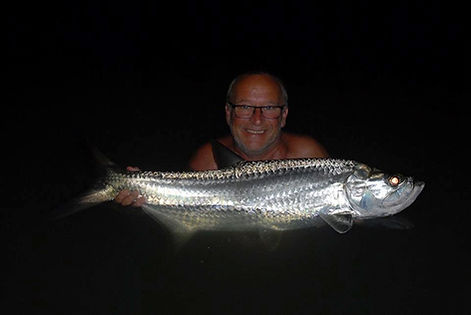
Name: Tarpon. Species: Megalops atlanticus. Thai name: Pla tarpon Atlantic. Max length: 2.8m. Max weight: 180kg. IGFA record: 130kg (286lb 9oz). Diet: fish, shrimp, crabs, frogs and insects. The tarpon is a new species to Gillhams only introduced in February 2010, and as such we cannot really give an accurate idea of how to target them. Up to October 2010 just two have been hooked and lost, one falling to float fished dead sea fish set two feet below a small pike float, the other to a fly angler using a green and yellow deceiver. On both occasions the fish where lost when jumping – tarpon anglers worldwide have a saying when a tarpon leaps; bow to the king! As they launch themselves skywards you must lower your rod to ease the pressure on the fish, or it is all over with this bone-tongued silver predator. We have had tarpon feeding from our hands when tossing them small sea dead fish; they are a shoal fish and easy to spot as they porpoise around the lake. To fish for them set up a rod with a small pike float set at around one meter, walk around until you see them and cast to them. We have fished for them in Costa Rica, and Nicaragua using the above method with circle hooks and sardines with great success. They are also a great sporting fish that readily take a fly, so try using any known tarpon fly patterns or deceivers on a floating line and sight cast to them. Due to other species in the lake no outfit lighter than a 10wt will be allowed if using medium sized flies, and should you choose to fish a large fly, change up to a 12wt outfit in case of accidental arapaima hook-ups. The tarpon is another fish that does not handle well in our hot climate, so have your camera ready for a quick shot. When releasing these fish support them in the water until they can support themselves and swim off. General facts on the tarpon: Tarpon are not indigenous to Thailand; they have huge range from the Eastern Atlantic – Senegal to Angola, with exceptional occurrences in Portugal, Azores and Atlantic coast of southern France, Western Atlantic – North Carolina, USA to Bahia, Brazil, with occasional occurrences off the American coast northward to Nova Scotia, Canada and southward to Cananéia, Brazil and Argentina, throughout Gulf of Mexico and Caribbean, and Eastern Central Pacific – Cobia Island in Panama via the Panama Canal. They are classed as freshwater, brackish and marine fish that inhabit coastal waters, bays, estuaries, mangrove-lined lagoons, and rivers. They are often found in river mouths and bays, and they enter fresh water in large schools, frequenting particular spots for years, feeding on fish like sardines, anchovies and crabs. Their swim bladder, which is attached to the esophagus, can be filled directly with air and allows the fish to live in oxygen-poor waters. They have a high fecundity; a 203cm female is estimated to produce over 12 million eggs. Tarpon can spawn in water that is temporarily isolated from the open sea. When their eggs hatch the transparent fry migrate into estuaries, and it is at this stage when they can be taken and slowly converted to live in fresh water. Tarpon are famous for their spectacular leaps when hooked, making them a highly regarded sport fish. They have a commercial value for their meat, which although very bony is marketed fresh or salted. The large scales of a tarpon are used in ornamental work and in preparation of artificial pearls; they used to be cultured commercially in Colombia for their scales, and they are becoming a very popular aquarium fish in Asia. Our tarpon were purchased from a private collector when they outgrew his aquarium.


Tiger Catfish
Name: Tiger catfish (sorubim barred). Species: Pseudoplatystoma fasciatum. Thai name: Pla sira. Max length: 1.5m. Max weight: 60kg. IGFA record: 35lbs.10ozs-16.17kgs. Diet: Fish, squid, frogs, earthworms, crustaceans, shrimp. To fish for our tiger catfish we recommend you use small sea fish deadbaits or squid fished on the bottom, in the margins and tight to the water hyacinth beds. The best times to target these fish is the first two hours of darkness. For hooklinks we recommend soft braids in 60lb bs fished in conjunction with size 1/0 ultra sharp hooks. Expect takes to be savage and fast, and these beautifully marked fish fight hard and deep, making repeated long, hard runs. They give their all in the fight, and for this reason must be given time to recover. When handling these fish be aware they have sharp pectoral and dorsal fins, which can inflict a nasty spike to you. Other than these features there are no other parts to worry about, and they do not posses teeth – as with most catfish they just have tough pads in their mouths. General facts on the Tiger Catfish: Tiger catfish are also known as shovel nosed tiger catfish and striped sorubim. As with many species in Thailand they were introduced here for the aquarium trade. The tiger catfish has a depressed head that is usually three times longer than it is wide. They are characterized by a shovel like projecting jaw with an exposed brush-like patch of teeth. The eyes of the tiger catfish are set to enable them to see up and down, and coupled with extremely long whiskers they are adept at hunting out food items in all conditions. Their bodies are silver with vivid black stripes, and they change shades of colour to suit the environment they live in.They also have a characteristic black lateral stripe, variable in width, that reaches from their snout and along the entire length of their body. No other member of the catfish family posses this feature. They have distinct speckled fins, which together with their stripes make perfect camouflage for hiding in weedbeds to ambush their prey. The tiger catfish originates from the Americas where they are distributed in ten countries between the Amazon, Orinoco, and Parana and Paraiba river basins. These catfish will not breed in still water; they need a sandy bottom in moving water. They are thought to build a nest and protect their young. Their spawning times are set more by non-flood conditions than particular times of the year.


Thai Mahseer

Name: Thai Mahseer Species: T. Tambroides Thai name: Pla Wien Biggest known fish: 35lb Lake rod caught record: 12lb Average weight: 5lbs Diet: Small Pellets, Fish, Shrimp, Snails & Worms. To fish for our Thai Mahseer, we recommend you carefully select your intended swim, they like to keep close to the margin shelf and work there way along close to the hyacinths. Feed small baits like maize, small pellet, stick pellet and if you are staying a few days feed the swim up over two or three days. Fish a light lead or float with your bait scattered around, plastic maize or pellet seems to pick these up more frequently, but a close second is fruit flavored pop-ups or more natural baits such as worm or snails. For even better results try moulding some sticky rice around your hook link, and then pulling your hair rigged pop-up into the rice ball. This method makes a deadly combination of a pop-up sitting over a small patch of rice. As with all the non-predatory fish in our lake, you need to create your own feeding area, and the tighter your feeding pattern the more fish you will concentrate in one area. The Mahseer is a bottom feeder which has an underslung mouth with protruding lips, very similar to the European barbel. They rummage around the lakebed searching for food, and a giveaway to location in still conditions is look for pinprick clouds of bubbles breaking the surface. They are a shoal fish so once you have a shoal feeding keep the feed going in to hold them in your fishing area. They are very easily spooked, so when one is hooked let them run out of your baited area before playing them in. They are a very hard fighting fish for their size, and often fool you into thinking they are bigger than they are when they go on long, hard runs. Be prepared for some unusual antics from these hardy fish; they sometimes jump when hooked, and even when you think the fight is over be prepared for them to jump from the landing net. When targeting these fish may also catch Siamese carp, Pacu, Tambiqui, plus all our other smaller carp species. A lot of our anglers use one rod with plastic maize on their baited area, and then fish with a fish bait on the outside edge of the baited area for predators who have come into the food zone attracted by the small bait fish feeding on the groundbait. Species Info The Thai Mahseer is part of the cyprinidae family of fish. The Thai Mahseer is widely spread through Thailand and can be found in both the Chaophraya and Mekong basins and the Salween and Maeklong Rivers, they can also be found in neighbouring countries such as Myanmar, Malaysia, Borneo. This Mahseer species is a heavily scaled predatory carp species which feeds on small fish, insects and crustaceans. The Thai Mahseer favours shallow oxygenated pools with gravel or sand and is mainly found in small streams and Thai rivers during the dry season. Once the rain season kicks in the adult Thai Mahseer move downstream. Around the middle of the year Thai Mahseer migrate upstream where they attempt to spawn.
Tilapia
Name: Tilapia. Species: Oreochromis aureus Thai name: Pla Nin. Biggest known fish: 13lb 6oz Lake rod caught record: 13lb 6oz Average weight: 3lb Diet: Boilies, pellet, worms, bread, plankton, algae. To fish for Tilapia in our main lake will take a bit of skill due to their excellent eyesight, they are also a fish that it preyed on them selves as they form a staple diet for a lot of species, this makes them very wary of taking bait. In the top lake it is a little easier due to the volume of fish and competitive feeding nature of the fish that live in there, tilapia confidently breed in both lakes. The best way to target these fish would be using a light set up, preferably a stick or waggler float, they like to stay in shallower water as they feel more confident of avoiding danger, so fishing close to the margin or hyacinth would be the preferred location. We would suggest using stick pellet soaked down, it beaks down quickly to replicate a groundbait mix. We would advise a small size hook and small hook bait, either worm threaded on the hook or small pieces of bread pinched around the hook would be perfect, but paste would also work well. Baiting we would recommend little and often using stick pellet fed around the float which will form a cloud attracting the tilapia and enticing them to feed, using worm or bread on the hook will hopefully tempt them to suck in hook bait as they filter feed through the groundbait mix. Species Info The tilapia is an imported species to Thailand and is a member of the Perciformes (perch-like fishes). It shares many of the same recognisable characteristics with the perch found throughout Europe. The tilapia originates from Africa, mainly in Rwanda and Uganda from some of the wildest and inaccessible waters on Earth. The tilapia is a hardy species and in the wild lives on a diet of zooplankton and other aquatic plant matter. The tilapia is easily recognisable with 7-12 vertical bands found on the cordial fin and has a sharp-spined dorsal fin very similar to that of a European perch. This tilapia species has a rough feel with a type of armoured scale and a dorsal fin full of sharp barbs, this acts as a good deterrent from any larger predatory fish as they can easily get lodged and stuck in the predators mouth. This fish is commonly found through upper layers feeding on insects, algae and other aquatic vegetation. The tilapia has been widely found throughout Thailand in fisheries and natural reservoirs and is a very popular table fish for the food market.

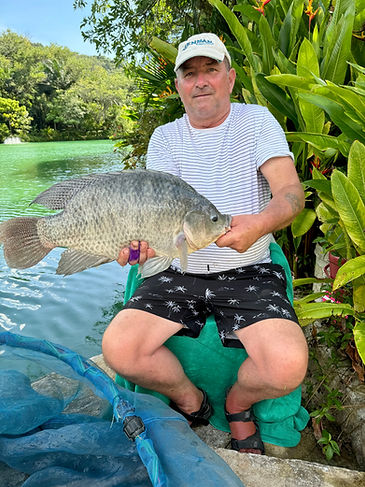
Wallago Attu

Name: Wallago attu. Species: Wallago attu. Thai name: Pla krao. Max length: 2.5m. Max weight: 50kg. IGFA record: 18.6kg. Diet: Fish, squid, animals, frogs, birds, shrimp, crustaceans, and molluscs. To fish for our wallago attu, squid is one of the better baits. As with all our fish, plumb the depth and find the deep channels that run around the plateaus. By pulling a lead slowly across the bottom, find a silted area, and fish in this area with a bait that is starting to go off and smell. Wallago species are scavengers, which clear up dead carcasses. Use strong hooklinks such as Kryston Ton-Up, as these fish have a double row of small needle-like teeth. You do not need wire, as they are cautious feeders and will detect wire traces and large hooks. You will also need to use a running lead, but due to fishing in silt this should be used with a lead on a stem leading to a sunken float with a run ring attached. Expect the takes to be slow and in small spurts, and if these fish sense any resistance they reject the bait. Once hooked they go on long, powerful runs. Their favourite trick is to swim around the rear of the plateau and hug the bottom – any ledge or hole gives them cover. If you do happen to get a fish that feels like it is snagged, more than likely it will be a wallago. Slacken off and put the rod back in the rest, wait for the line to move off, and then lean into the fish and keep the pressure on to stop the fish going back to the same spot. Being a member of the wels catfish family they are capable of swimming backwards as well as forwards, so be prepared at the netting stage. As for your photo, once caught, more of our fishermen lose the fish when trying to hold them, so you are best to wear gloves, as they are very slippery and writhe when you hold them. As with a lot of our fish, do not put your fingers near their mouths, as their needle-like teeth can inflict a nasty bite. These fish are not an easy fish to target, but are well worth the effort for a species not caught by many. General facts on the wallago attu: Wallago attu is a species of catfish in the family siluridae or sheathfish. The fish is commonly known by its genus name wallago. It is found in large rivers and lakes throughout Asia from Pakistan to Vietnam and Indonesia, and is also reported from Afghanistan. The wallago is very popular throughout Asia for its fine eating qualities, and in Bengal and Assam, it is known as boal. It’s common to find huge frogs and fish inside its stomach when cut for cooking. It has been claimed that in some areas of Thailand the natives fear the species because of its believed habit of eating small ducks, dogs, and small children. The wallago attu is silver in colour and has a broad head with two pairs of barbules; one set short and the other long. It has double rows of vomerine teeth, small eyes, a peculiar long dorsal fin, and an anal fin running from just below their pectoral fins to their tails. They are shaped like a dagger, hence the nickname sheathfish. In the wild the wallago attu inhabits large rivers, canals and lakes. They live in slow moving water in the mud and silt where they hide in any holes, especially undercut banks. They spawn between May and July only in the hours of darkness. They pair up and spawn near the surface over flooded grassland where streams enter the main body of water. For this reason we do not believe the wallago attu will breed here at Gillhams.
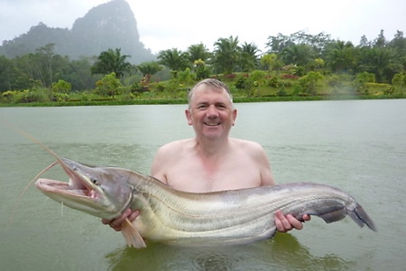
Wallago Leeri
Name: Wallago leeri. Species: Wallago leeri. Thai name: Pla ituk. Max length: 3m. Max weight: 100kg. IGFA record: Vacant. Diet: Fish, squid, animals, frogs, birds, shrimp, crustaceans, and molluscs. (and humans!) To fish for our wallago leeri the tactics are virtually the same as for the attu. Fish are one of the best baits, or rotting meat. As usual plumb the depth, pull a lead slowly across the bottom find the deep silted areas, and fish in the silt with bait that has gone off – the smellier the better. Wallago leeri are scavengers that feed on dead rotting carcasses, and they keep the lakebed clean. Use strong hook links such as Kryston Ton-Up as these fish have a double row of needle teeth. You do not need wire, as they are cautious feeders and will detect wire traces. For this fish you will be using a lead on a stem leading to a sunken float with a run ring attached. Expect the takes to be fast one-toners, but if these fish sense too much resistance they eject the bait. Once hooked they go on long, powerful runs, and as with the attu their favourite trick is to swim round the rear of the plateau and hug the bottom. Any ledge or hole gives them somewhere to back into and hug the bottom, which results in stalemate. If the fish feels like it is snagged, more than likely it will be a wallago, as there are no snags in our lake. Slacken your line, put the rod back in the rest and wait for the fish to move off. Once this happens, bully the fish away from their lair. Being a member of the wels catfish family they are capable of swimming backwards as well as forwards, so be prepared when they approach the landing net. When you want your photo, ask our guide for a pair of gloves, as they twist and turn when you hold them. They are a very aggressive fish and will try to turn and bite you. Keep your hands clear of their mouths, and if you land a big one, let our guide support the head end. The wallago is another fish that we inject prior to release. As with the attu they are not an easy fish to target, but if you like adding different species to your list they are worth targeting. The bottom end of the lake near the restaurant is the deepest part of our lake at 8m, and this is where they live. General facts on the wallago leeri: Wallago leeri is another species of the catfish family siluridae or “sheathfish. They are commonly known by the name wallago. The body of wallago leeri is large and slender; the last 2/3 of the fish’s body being the tail. Their body colour is made up of black and brown. All their fins are the same colour as there body. They have a broad head with a depressed snout, and their mouth is very deeply clefted; its corner reaching far behind eyes with a double row of teeth, two barbules in two pairs, one set short the other very long, and very small eyes. It has a small dorsal fin with a very long anal fin resembling the blade of a sword, which gives them the local name of the sheathfish. They are found throughout Asia in large rivers and lakes that are river fed. Although the wallago leeri appears to be less common than the wallago attu, it has almost the same distribution range, and like its relative, the wallago leeri attains sizes over 2m. They migrate from Cambodia and Laos down the Mekong River into Thailand around October to November, where they run up small streams to spawn after heavy rain. They breed in pairs under the cover of darkness over flooded grassland. This is when they are at their most vulnerable, as local fishermen kill them, because they are destructive to other more valuable food fish. Once they have spawned they abandon their eggs and travel back to their deep, silted lairs. Sometimes referred to as the giant catfish, they originate from parts of Thailand, Java, India and Burma. They are highly predatory, pure carnivores, and considered dangerous by the local fishermen, with their large mouth, formidable jaws and double band of conical teeth. They are also known as the human-eating fish, as in India where the locals lay their dead to rest in the rivers, they are rumoured to have become conditioned to feeding on human corpses! Over the centuries this has created a fish that has a taste for humans! The fish’s habits are well documented, and traces of human corpses have been recovered from the fish’s stomach according to well known fishery experts. The fish is very rarely eaten, as they are said to carry the souls of the dead and taste of human flesh. By killing them local superstition claims it releases the spirits of the dead. Nearly all this is myth and legend, but it does make the wallago leeri a special case in the fish world. For our clients’ peace of mind, all our leeri were bred and grown on in fish farms for their valuable use as cleaners of dead and rotting fish, keeping lakes like ours in pristine condition.
